Halal Food in the United States: 2026 Guide for Residents and Travelers
How Muslims in the US shop and eat halal in 2026. IFANCA, HMS, and IFANCC certification marks, halal availability at Walmart, Costco, Whole Foods, Trader Joe's, Kroger, HEB, Wegmans, ingredient pitfalls in mainstream packaged food, and city-by-city halal hubs in Dearborn, NYC, Houston, Chicago, the Bay Area, and DMV.
Posted by
Related reading
Halal Food in the UK: 2026 Guide for Residents and Travelers
How Muslims find halal food across the UK in 2026. The HMC vs HFA debate, halal ranges at Tesco, Sainsbury's, Asda, Morrisons, M&S, Waitrose, Aldi, and Lidl, hidden non-halal traps in sweets and ready meals, regional concentration in London, Birmingham, Leicester, Manchester, and Bradford, and which scanner apps work best in the UK.
Halal Food in Canada: 2026 Guide for Residents and Travelers
How Muslims in Canada find halal food in 2026. HMA, ISNA Canada, and IFANCC certification, halal availability at Loblaws, Sobeys, Metro, Walmart Canada, Costco, and No Frills, GTA halal hubs, Quebec considerations, and which scanner apps work for Canadian barcodes and ingredient lists.
Halal Food in Japan: 2026 Guide for Muslim Travelers and Residents
Eating halal in Japan in 2026. Why dashi, mirin, and sake make most Japanese food not halal by default, JHA and Japan Halal Association marks, halal-friendly konbini items, halal-certified restaurants in Tokyo, Osaka, Kyoto, prayer rooms, and how AI scanner apps handle Japanese ingredient lists.
Most packaged products in mainstream US supermarkets are not halal-certified. Muslim residents and travelers in the United States typically rely on three things: dedicated halal grocers and butchers for meat, a handful of mainstream chains that stock IFANCA or HMS-certified items in select regions (Whole Foods, Costco, Trader Joe's, HEB in Texas, Wegmans in the Mid-Atlantic), and an ingredient-scanner app for everything else. There is no single "halal aisle" in most US chains, so the ingredient label is what decides.
The United States is home to roughly 4.5 million Muslims (Pew Research Center, 2024 estimates), but unlike the UK or Singapore it has no government-issued national halal mark. Private certifiers issue marks inconsistently, chains carry halal items differently from state to state, and most national-brand packaged food is not halal-certified at all. This guide covers how to actually shop and eat halal in the US in 2026, where to find certified products, which ingredients to flag, and which cities have the strongest halal infrastructure.
Halal Certification Bodies in the US
The US has several private halal certifiers. The marks you are most likely to see on a label are:
- IFANCA (Islamic Food and Nutrition Council of America). The most widely recognized US halal certifier. The "Crescent-M" mark appears on certain cheeses, some Nestlé and Mars products, frozen meals, snacks, and a range of nutraceuticals. If you see only one halal mark in a mainstream US store, it is usually this one.
- HMS (Halal Monitoring Services). Focuses on zabihah hand-slaughter meat. Certifies many independent halal butchers and meat brands sold through specialist halal grocers.
- IFANCC (Islamic Food and Nutritional Certification Council). Smaller certifier covering packaged-food and meat brands.
- USHC (US Halal Chamber of Commerce). Trade-oriented certifier with a smaller product footprint.
- HFSAA, AHF, and others. Regional or category-specific certifiers occasionally seen on imported or specialty products.
None of these is government-backed. When you see a mark you don't recognize, treat it the same way you would in any non-Muslim-majority market: cross-check the certifier's website and the specific ingredients.
Halal Availability at Major US Grocery Chains
| Chain | Halal-Certified Meat | Halal Packaged Goods | Best For |
|---|---|---|---|
| Whole Foods Market | Yes (Saffron Road, select chicken brands) | Saffron Road meals, Mighty Spark, select cheeses | Prepared halal meals and quality proteins |
| Costco | Region-dependent (zabihah chicken in some warehouses) | Selected IFANCA-marked snacks and dairy | Bulk shopping where regional halal stock exists |
| Trader Joe's | No dedicated halal meat line | Several IFANCA-marked items; many vegetarian-by-default snacks | Vegetarian halal-friendly basics |
| Walmart | Region-dependent (Crescent, Midamar in some states) | Limited but present | National-scale availability where stocked |
| Kroger / King Soopers / Ralphs | Region-dependent halal meat | Selected halal-certified items | Mainstream chain with regional halal stock |
| HEB (Texas) | Halal meat sections in major Texas metros | Selected certified items | Houston, Dallas, Austin, San Antonio shoppers |
| Wegmans (NY / NJ / PA / VA) | Halal meat counter in select stores | Selected packaged items | Mid-Atlantic and Northeast halal grocery |
| Publix (Southeast) | Limited | Some certified packaged items | Florida and Georgia basics |
| Aldi / Lidl | Generally no halal-certified meat | Vegetarian-by-default lines | Cheap basics; verify each ingredient list |
| Independent halal grocers | Yes (zabihah default) | Wide selection of imports and certified brands | Best overall halal coverage and best meat |
Stock varies sharply by state and metro area. A Costco in Southern California or Northern Virginia may carry zabihah chicken that the same chain in Iowa does not. Check the freezer aisle and meat counter before assuming a product is or isn't there.
Common Ingredient Pitfalls in US Packaged Food
Most US packaged food is engineered around dairy, corn, soy, and cheap stabilizers. The ingredients that catch Muslim shoppers off guard most often are:
- Gelatin in candy, marshmallows, and yogurt. Default US gelatin is pork-derived and haram. Brands like Haribo (US production), Jell-O, regular marshmallows, gummy vitamins, and many yogurts use it. See our Haribo halal guide for the country-by-country breakdown.
- Mono and diglycerides (E471) in baked goods. Found in most commercial bread, tortillas, ice cream, and packaged cakes. Source can be plant or animal and is rarely disclosed; treat as mushbooh unless the manufacturer confirms vegetable origin.
- Alcohol-based vanilla extract. Standard "vanilla extract" in US baked goods, ice cream, and chocolate uses ethanol as the carrier. Schools of jurisprudence differ on negligible amounts; flavorings labeled "artificial vanilla" or "vanillin" are typically alcohol-free.
- L-cysteine in commercial bread and pizza dough. Often derived from human hair or duck feathers. Dough conditioners in major bagel and pizza chains may include it.
- Pepsin and rennet in cheese. Pepsin is typically pork-derived. Rennet may be animal or microbial; if the label says "enzymes" without specifying, treat as mushbooh.
- Wine vinegar and cooking wine. US salad dressings, marinades, and frozen meals often contain red wine vinegar, sherry, or cooking wine. Most schools consider trace vinegar permissible after fermentation, but cooking wine and sake-flavored sauces are generally not.
- Carmine / cochineal (E120). An insect-derived red dye in some yogurts, candies, and juice drinks. Hanafi rulings differ on insect-derived ingredients; most US shoppers avoid it.
For a deeper walkthrough of how AI scanners flag these in real ingredient lists, see our AI halal food checking guide.
City-by-City Halal Hubs in the US
Halal infrastructure in the US is concentrated. If you are traveling and want to plan around halal availability, the strongest metros are:
- Dearborn, Michigan. The most concentrated halal-grocery scene in the country. Default-halal supermarkets (Super Greenland, Al-Asmar, Hashem's) carry full grocery ranges where the entire meat counter is zabihah.
- New York City and New Jersey. Strong on Bay Ridge and Astoria halal corridors, Jersey City, Paterson, Edison-Iselin. Halal carts and full halal restaurants are standard. Wegmans and Stop & Shop carry halal meat in many NJ stores.
- Houston and the broader Texas Triangle. HEB halal meat counters in major Texas metros. Hillcroft / Mahatma Gandhi District in Houston is a halal grocery cluster.
- Chicago suburbs (Bridgeview, Bolingbrook, Naperville). Strong halal grocery and restaurant density in the southwest suburbs.
- San Francisco Bay Area. Fremont, Hayward, San Jose, and Newark have substantial halal grocery and restaurant options. Costco warehouses in the East Bay often carry halal meat.
- DMV (DC, Maryland, Northern Virginia). Sterling, Herndon, Falls Church, and Silver Spring have well-stocked halal grocers. Wegmans and Costco carry halal in several Northern Virginia stores.
- Los Angeles and Anaheim. Tehrangeles (Westwood) and Little Arabia (Anaheim) have full halal grocery and restaurant clusters.
Outside these metros, halal availability drops off quickly. In most of the rural Midwest, the South outside Texas / Florida, and the Mountain West, an ingredient-scanner app and online halal mail-order are usually the fallback.
Halal Restaurants in the US
For dining out, the most reliable approach is to check the restaurant's certification directly rather than trust assumptions about cuisine origin. Useful resources:
- Zabihah.com remains the largest crowd-sourced database of halal restaurants and grocers in the US, with reviews and certification notes.
- National halal-certified chains: The Halal Guys, Halal Shack, Naf Naf Grill (most locations), Cava (some proteins), Shake Shack's chicken at select branches. Always confirm the specific location.
- Independent local halal restaurants are the backbone of dining out for most US Muslim families. Pakistani, Afghan, Turkish, Lebanese, Bosnian, Yemeni, and Senegalese cuisines are typically halal by default at family-run restaurants in Muslim-population metros.
- Beware of cooking wine and bacon-fat seasoning at non-halal restaurants that look halal on the surface (sushi bars use mirin and sake, many Italian-American kitchens use bacon fat in tomato sauces, some chicken-finishing oils contain animal fat).
How a Scanner App Fits In
Because most US packaged food is not halal-certified and ingredient lists are dense with E-codes, hidden enzymes, and ambiguous flavorings, an ingredient-scanner app is the practical way to shop in mainstream chains.
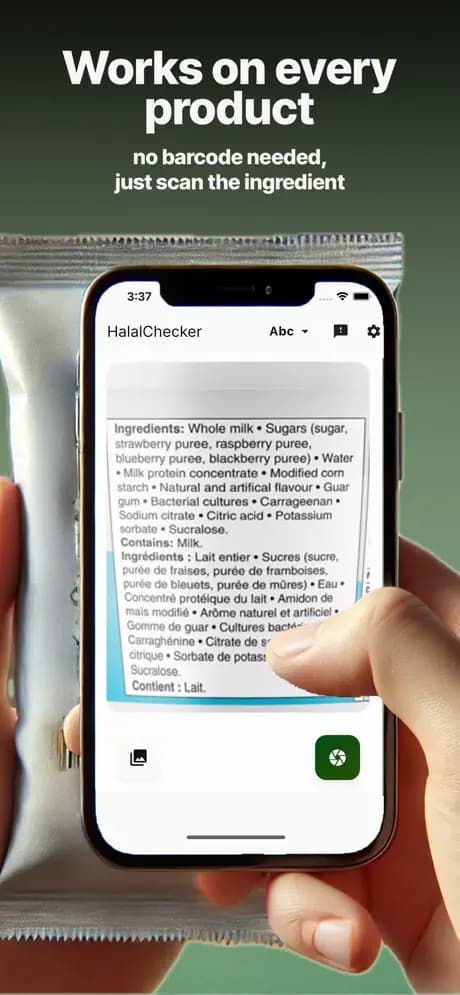
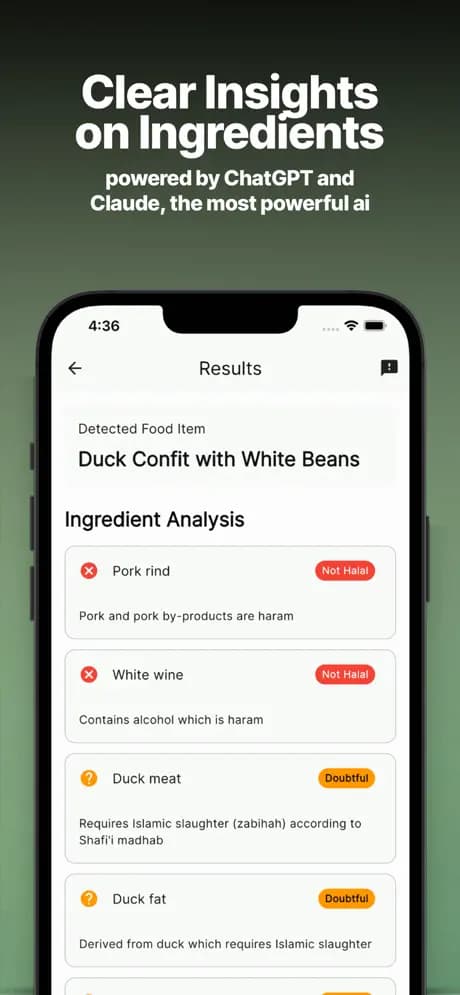
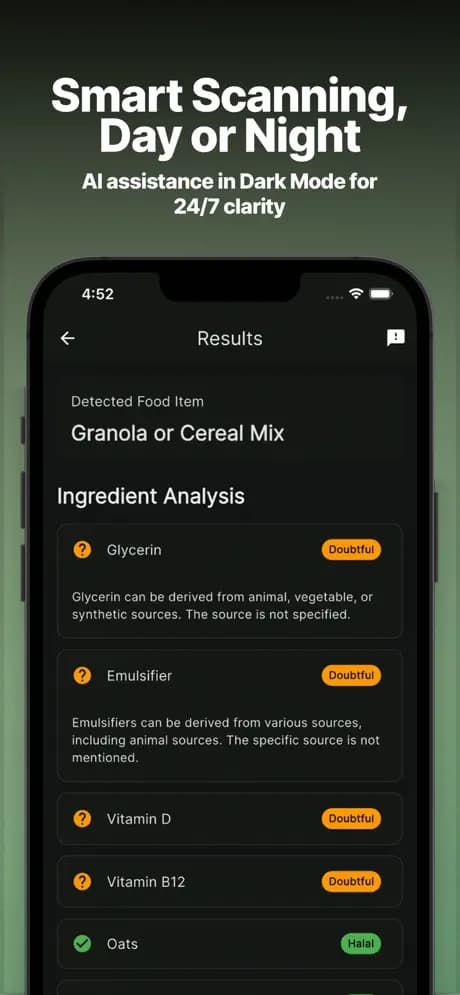
HalalChecker AI works on US barcodes, ingredient lists in English, and product photos. For US shoppers in particular, the app is most useful in three situations:
- At Trader Joe's, Aldi, Whole Foods, and Costco where private-label brands have no halal mark even when the product itself is halal.
- On packaged ready meals, frozen pizzas, and snacks where the gelatin / mono-and-diglycerides / wine-vinegar question is the actual blocker.
- For travelers visiting unfamiliar metros where the local store brand is unknown.
For an app comparison covering US-specific use cases (community barcode databases vs AI ingredient analysis), see our best halal food scanner apps roundup and HalalChecker AI vs Scan Halal.
Frequently Asked Questions
Is there a halal aisle at Walmart, Costco, or Kroger?
There is no national halal aisle. Some Walmart, Costco, and Kroger stores carry halal-certified meat or packaged items in specific states based on local demographics, but national stock is not standardized. The IFANCA mark on individual products is more reliable than any "halal section" assumption.
Is meat at US Whole Foods halal by default?
No. Whole Foods carries halal-certified brands such as Saffron Road and select chicken lines but the regular meat counter is not halal. Look for the IFANCA or HMS mark on the specific package.
What is the difference between IFANCA and HMS?
IFANCA certifies a wide range of packaged food, dairy, confectionery, and nutraceuticals across the US. HMS focuses on zabihah hand-slaughter meat and is more common at independent halal butchers. Both are recognized; many Muslim consumers accept both, though some prefer HMS specifically for meat.
Is Trader Joe's halal?
Trader Joe's does not carry a dedicated halal meat line, but many of its private-label products are vegetarian-by-default or carry IFANCA marks. Plant-based snacks, dairy basics, and vegetarian frozen meals are often halal. Check each label.
How do I find halal restaurants when traveling in the US?
Zabihah.com remains the most comprehensive crowd-sourced halal restaurant directory in North America. Google Maps reviews and specific halal-restaurant Reddit communities for each city (r/nyc, r/chicago, r/houston) are useful supplements.
Are pork-free products automatically halal?
No. Pork-free does not mean halal. Beef, chicken, and lamb still need to be from zabihah-slaughtered animals. Common non-pork ingredients (alcohol-based vanilla, animal-derived enzymes, gelatin from non-zabihah cattle) can also be haram.
Can I get halal food at US gas stations and rest stops?
Most US gas-station hot food is not halal. Reliable fallbacks on road trips are sealed shelf items: nuts, fruit, dairy without animal-source enzymes, IFANCA-marked snacks, and bottled drinks. Plan for halal restaurant stops in advance using Zabihah or Google Maps.
Is most American cheese halal?
It depends on the rennet source. American cheese, mozzarella, cheddar, and parmesan can use animal rennet (often pork-derived) or microbial rennet. Labels that say "microbial enzymes" or "vegetable rennet" are typically halal. Labels that just say "enzymes" are mushbooh; cheeses with an IFANCA mark are the safest pick.
Bottom Line
The US is workable but uneven. In strong halal metros (Dearborn, NYC / NJ, Houston, Chicago suburbs, Bay Area, DMV, LA / Anaheim) you can run a full halal household with mostly local sourcing. In other regions, the playbook is mainstream chains plus ingredient-scanner verification plus online mail-order for meat. The IFANCA mark is the most reliable halal signal on mainstream-store packaging; an AI scanner app is the bridge for everything that has no mark at all.
Sources
- IFANCA, official certifier directory and Crescent-M product listings (ifanca.org).
- HMS (Halal Monitoring Services USA) certified butcher and brand directory.
- Pew Research Center, US Muslim population estimates.
- Saffron Road and Midamar published store-locator data for Whole Foods, Costco, and Walmart distribution.
- Zabihah.com, crowd-sourced US halal restaurant and grocery directory.
- SANHA and MHCT E-number reference tables for ingredient classifications cited above.
🔍 Is Your Food Really Halal?
Don't guess - know for sure! Our free app scans food labels in seconds and tells you if ingredients are halal or haram. Perfect for shopping in non-Muslim countries. Join 100,000+ Muslims who trust HalalChecker AI for safer food choices.