Halal Food in Japan: 2026 Guide for Muslim Travelers and Residents
Eating halal in Japan in 2026. Why dashi, mirin, and sake make most Japanese food not halal by default, JHA and Japan Halal Association marks, halal-friendly konbini items, halal-certified restaurants in Tokyo, Osaka, Kyoto, prayer rooms, and how AI scanner apps handle Japanese ingredient lists.
Posted by
Related reading
Halal Food in the United States: 2026 Guide for Residents and Travelers
How Muslims in the US shop and eat halal in 2026. IFANCA, HMS, and IFANCC certification marks, halal availability at Walmart, Costco, Whole Foods, Trader Joe's, Kroger, HEB, Wegmans, ingredient pitfalls in mainstream packaged food, and city-by-city halal hubs in Dearborn, NYC, Houston, Chicago, the Bay Area, and DMV.
Halal Food in the UK: 2026 Guide for Residents and Travelers
How Muslims find halal food across the UK in 2026. The HMC vs HFA debate, halal ranges at Tesco, Sainsbury's, Asda, Morrisons, M&S, Waitrose, Aldi, and Lidl, hidden non-halal traps in sweets and ready meals, regional concentration in London, Birmingham, Leicester, Manchester, and Bradford, and which scanner apps work best in the UK.
Halal Food in Canada: 2026 Guide for Residents and Travelers
How Muslims in Canada find halal food in 2026. HMA, ISNA Canada, and IFANCC certification, halal availability at Loblaws, Sobeys, Metro, Walmart Canada, Costco, and No Frills, GTA halal hubs, Quebec considerations, and which scanner apps work for Canadian barcodes and ingredient lists.
Japan is the most challenging mainstream travel destination for Muslim visitors in 2026 because three near-universal Japanese ingredients (dashi made with bonito and pork, mirin and sake in sauces, and gelatin in desserts) are present in foods that look halal-safe on the surface. The practical approach is: stick to halal-certified restaurants in major cities (Tokyo, Osaka, Kyoto, Hiroshima), scan konbini and supermarket labels with an AI app, and treat any unmarked cooked dish as mushbooh by default. Halal certification in Japan is mostly issued by the Japan Halal Association (JHA), the Japan Muslim Association (JMA), and Nippon Asia Halal Association (NAHA).
Japan has a small but growing halal infrastructure driven by tourism. Roughly 230,000 Muslims live in Japan (Pew estimates, 2024), and over 1.5 million Muslim tourists visited Japan annually before the pandemic, with a recovery underway through 2025 to 2026. Tokyo, Osaka, Kyoto, Nagoya, Fukuoka, and Hiroshima have established halal restaurant clusters. Outside those cities, halal options drop off sharply and travelers often default to vegetarian or self-catered halal options. This guide covers what to eat, what to avoid, and how to verify packaged products.
Why Japanese Food Is Hard for Halal Travelers
Most Japanese cuisine is built around four base ingredients that complicate halal eating:
- Dashi. The umami stock at the base of nearly every soup, sauce, and rice dish in Japan. Standard dashi uses bonito flakes (katsuobushi, fish-derived, halal in most schools) plus kelp, but variants use pork-bone broth (tonkotsu base in many ramen and sauce systems) or chicken stock. The ingredient is not always disclosed on a menu.
- Mirin and sake (cooking). Sweet rice wine and sake are added to most teriyaki sauces, glazes, broths, and side dishes. The alcohol is not always cooked off completely. Most schools consider this haram in the ingredient sense, regardless of residual alcohol level.
- Gelatin. Pork-derived gelatin is common in Japanese desserts, jellies, gummies, and yogurts, and shows up in unexpected places like cold-cut packaging and some ramen broths.
- Lard and pork fat in "chicken" or "vegetable" ramen. Many ramen broths labelled chicken or vegetable are finished with pork fat or tonkotsu (pork-bone broth) at the kitchen level even when the menu doesn't say so.
In a Japanese restaurant that does not advertise as halal, assume that miso soup, ramen, teriyaki, tonkatsu, gyoza, and most sauces include at least one of these. Even seemingly simple sushi often uses mirin in the rice vinegar mix.
Halal Certification Bodies in Japan
- Japan Halal Association (JHA). The largest halal certifier in Japan. Recognized internationally, with JAKIM (Malaysia) recognition in many product categories.
- Japan Muslim Association (JMA). Long-established Muslim community body that also issues halal certifications.
- NAHA (Nippon Asia Halal Association). Active in restaurant certification and packaged food.
- Muslim Professional Japan Association (MPJA). Smaller but growing certifier.
- Local mosque-issued marks for individual restaurants, common in tourist areas.
The mark you see most in restaurants and on packaged food is JHA. JMA and NAHA marks are also widely accepted. If you see an unfamiliar Japanese halal logo, look up the certifier's website and check whether it's recognized by JAKIM, MUI, or other major Muslim-majority country bodies.
Halal-Friendly Konbini and Supermarket Items
Japanese convenience stores (7-Eleven, Lawson, FamilyMart, Ministop) are everywhere and open 24/7. They are the practical backstop for halal travelers when restaurants are closed or unfamiliar. Items that are typically halal-friendly (verify each pack):
- Plain onigiri (rice balls). Salt onigiri (shio musubi) and umeboshi (pickled plum) onigiri are typically vegetarian. Tuna mayo and salmon onigiri use fish that is halal in most schools, but check for any added animal-source flavoring.
- Plain bread (shokupan) from major brands, though watch for emulsifiers (E471) and shortening.
- Fresh fruit, hard-boiled eggs, plain milk and yogurt (verify yogurt for gelatin).
- Pre-packed salads without dressing, plus vegetarian sushi (kappa maki, oshinko maki, inari).
- Instant cup ramen labelled halal from brands such as Otsuka Foods Bonchi (some lines) and SajiMurai. JHA certification when present is the easy tell.
Items to be cautious about even when they look simple include inari (sometimes uses dashi with pork base), tamago sushi (egg with mirin), most katsu and karaage products, all noodle soups, and most sauces and dressings.
Halal Restaurant Hubs in Japan
| City | Strongest Halal Areas | Typical Cuisines Available |
|---|---|---|
| Tokyo | Asakusa, Shinjuku, Shibuya, Akihabara, Roppongi, Ueno, Otsuka (near Tokyo Camii mosque) | Halal Japanese, Turkish, Indonesian, Pakistani, Indian, Egyptian |
| Osaka | Namba, Shinsaibashi, Tennoji (near Osaka Camii mosque) | Halal Japanese, Indonesian, Malaysian, Turkish |
| Kyoto | Around Gion, Nishiki Market, Kyoto Station; smaller overall scene | Halal kaiseki and ramen options, Indonesian, Indian |
| Nagoya | Sakae, Osu | Halal Indonesian, Pakistani, growing Japanese |
| Fukuoka | Hakata, Tenjin | Halal ramen options, Pakistani, Indonesian |
| Hiroshima | Around Hiroshima Station and Peace Memorial Park | Halal okonomiyaki options exist; smaller Asian cuisine cluster |
| Sapporo | Susukino, around Hokkaido University | Halal ramen, Indonesian student community |
Tokyo Camii and Osaka Camii (Turkish-style mosques) often have associated cafes or recommended halal restaurants nearby. University towns with significant Indonesian or Malaysian student populations (Tsukuba, parts of Sendai, parts of Sapporo) usually have at least one full halal restaurant.
Tips for Muslim Travelers in Japan
- Plan halal meals around lunch and dinner; use konbini for breakfast and snacks. Halal restaurants are not on every corner, even in Tokyo.
- Use HalalGourmet.jp, Halal Trip, or HalalNavi for restaurant lookups. Their data is more current than Google Maps for halal certification status.
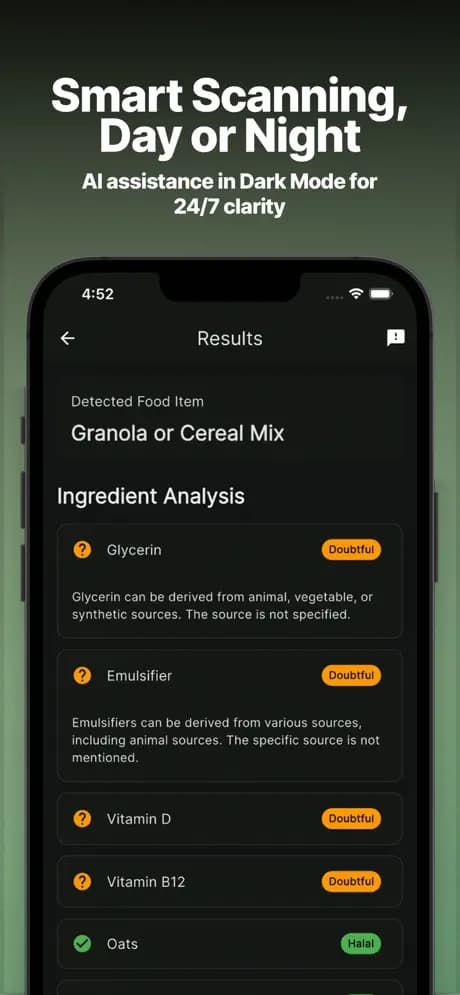
- Carry the AI scanner app for konbini and supermarket runs. HalalChecker AI reads Japanese ingredient labels in kanji and katakana.
- Pre-book hotels with Muslim-friendly rooms (Halal Trip and Booking.com mark these). Many Tokyo and Osaka hotels now offer prayer mats, qibla indicators, and sometimes halal breakfast.
- Prayer rooms. Major airports (Narita, Haneda, Kansai), train stations (Tokyo Station, Shinjuku, Shin-Osaka), and large department stores and shopping malls increasingly have prayer rooms. The HalalNavi app maps them.
- Carry spare halal snacks from your home country or buy them at the airport on arrival; rural Japan has very limited halal options.
- Vending machines are abundant. Plain water, tea, coffee (verify creamer), and fruit juice are usually fine.
Reading Japanese Ingredient Labels
Common kanji and katakana to watch for on packaged products:
- 豚肉 / ポーク (pork). Hard avoid.
- 豚脂 / ラード (pork fat / lard). Hard avoid.
- みりん (mirin). Sweet rice wine; alcohol-based.
- 料理酒 (cooking sake). Alcohol-based.
- 洋酒 / ワイン / ブランデー (wine, brandy). Alcohol-based.
- ゼラチン (gelatin). Default pork-derived in Japan unless otherwise specified.
- 動物性 (animal-derived). Source not specified; treat as mushbooh.
- 植物性 (plant-derived). Typically halal when paired with named oils or emulsifiers.
- カツオエキス / ポークエキス (bonito extract / pork extract). Bonito is halal in most schools; pork extract is haram.
HalalChecker AI's OCR reads Japanese labels and translates ingredient lists. Tayib explicitly markets translation for Japanese labels and is a strong companion for travelers in Japan; see our HalalChecker AI vs Tayib comparison for details.
Halal-Certified Japanese Brands
A growing number of Japanese food and snack brands carry JHA certification. Examples that travelers commonly see:
- Otsuka Foods (selected SoyJoy and Pocari Sweat lines).
- Nissin and Ajinomoto have specific halal lines for export markets that occasionally appear in Japan.
- Yamamori curry sauce (halal-certified variant for Japan and Southeast Asia).
- Selected Pocky lines (export halal versions; standard Japan-domestic Pocky often uses non-halal milk derivatives or alcohol-based flavorings, see our Pocky in Japan halal guide).
- Specialty halal bento brands at airports and selected city stores.
Major chocolate brands (Meiji, Glico, Lotte) have some halal-certified variants in Muslim-majority export markets, but most standard Japan-domestic chocolate uses alcohol-based flavorings or non-halal emulsifiers and is not certified.
Frequently Asked Questions
Is sushi halal in Japan?
Most Japanese sushi rice is seasoned with vinegar that contains mirin (sweet rice wine). Even basic plain sushi at a non-halal restaurant typically includes alcohol-based seasoning. Halal sushi exists at certified restaurants in Tokyo and Osaka but standard Japanese sushi should be treated as mushbooh.
Is ramen halal in Japan?
Standard Japanese ramen uses dashi or pork-bone broth and is not halal. Halal ramen exists at certified restaurants (notably Naritaya, Ouca Halal Ramen, Shinjuku Gyoen Ramen Ouka, and several JHA-certified branches in Tokyo and Osaka). Always confirm certification and check for halal stamps in store.
Are vegetarian dishes in Japan halal?
Not automatically. Many Japanese vegetarian dishes still contain dashi (often bonito-fish or pork-bone), mirin, sake, or alcohol-based vinegars. Vegan dishes labeled "vegan" (in English) at modern restaurants are usually safer than "vegetarian" at traditional restaurants.
Is konbini food halal in Japan?
Some plain items (rice balls with vegetable fillings, plain bread, fruit, plain dairy) are halal-friendly by ingredients, but a large fraction of konbini hot food and prepared meals includes dashi, gelatin, or alcohol-based seasonings. Read each label or use a scanner app.
What about Pocky and Japanese candy in general?
Standard Japan-domestic Pocky uses ingredients that are mushbooh (alcohol-based flavorings, animal-derived emulsifiers, fermentation alcohol in some lines). Halal-certified Pocky variants for Muslim-majority export markets exist but are different SKUs. See our Pocky deep matcha halal guide for the SKU-by-SKU breakdown.
Where can I pray in Japan?
Prayer rooms are increasingly common at Narita, Haneda, and Kansai airports, at major Tokyo and Osaka department stores (Takashimaya, Mitsukoshi, Lalaport malls), at JR Tokyo, Shinjuku, and Shin-Osaka stations, and at major shopping districts. Tokyo Camii and Osaka Camii are full mosques open to visitors. The HalalNavi and Halal Trip apps map prayer rooms.
Is alcohol residue in cooked food halal?
The four major Sunni schools differ on this. The widely-held mainstream view is that alcohol added as an ingredient in cooking remains haram regardless of how much cooks off, because the intention to use alcohol exists. Some scholars allow trace amounts that result purely from natural fermentation. Practising travelers in Japan typically avoid mirin and sake in cooked dishes.
Is it possible to do a halal-only trip to Japan?
Yes, in major cities. Tokyo, Osaka, Kyoto, and Hiroshima now have enough JHA-certified restaurants and Muslim-friendly hotels to plan a multi-day visit without compromising. Rural Japan still requires self-catering or vegetarian-by-default fallbacks.
Bottom Line
Japan rewards halal travelers who plan ahead. Stick to JHA-certified restaurants in major cities, use konbini for breakfast and snacks with label scanning, treat dashi, mirin, sake, and gelatin as the four major non-halal traps, and use an AI app that reads Japanese ingredient labels. Tokyo and Osaka are the easiest cities; Kyoto, Nagoya, Fukuoka, Hiroshima, and Sapporo are workable; rural Japan is hard and usually means self-catering.
Sources
- Japan Halal Association (JHA), official certified product and restaurant directory (jhalal.com).
- Japan Muslim Association (JMA), certification listings.
- Japan National Tourism Organization (JNTO), Muslim-friendly travel resources.
- HalalGourmet.jp and HalalNavi restaurant and prayer-room directories.
- Tokyo Camii and Osaka Camii published halal-restaurant recommendations.
- MasterCard-CrescentRating Global Muslim Travel Index 2024, Japan profile.
- Glico, Otsuka Foods, and Nissin published halal product listings.
🔍 Is Your Food Really Halal?
Don't guess - know for sure! Our free app scans food labels in seconds and tells you if ingredients are halal or haram. Perfect for shopping in non-Muslim countries. Join 100,000+ Muslims who trust HalalChecker AI for safer food choices.