Is Haribo Halal? (2026 Guide to the Goldbears Pork Gelatin Trap)
Standard Haribo uses pork gelatin and is not halal. A separately certified Haribo Halal line manufactured in Turkey with beef gelatin is sold in Muslim-majority markets. This guide shows how to tell them apart by country, packaging, and product line.
Posted by
Related reading
Halal Food in the United States: 2026 Guide for Residents and Travelers
How Muslims in the US shop and eat halal in 2026. IFANCA, HMS, and IFANCC certification marks, halal availability at Walmart, Costco, Whole Foods, Trader Joe's, Kroger, HEB, Wegmans, ingredient pitfalls in mainstream packaged food, and city-by-city halal hubs in Dearborn, NYC, Houston, Chicago, the Bay Area, and DMV.
Halal Food in the UK: 2026 Guide for Residents and Travelers
How Muslims find halal food across the UK in 2026. The HMC vs HFA debate, halal ranges at Tesco, Sainsbury's, Asda, Morrisons, M&S, Waitrose, Aldi, and Lidl, hidden non-halal traps in sweets and ready meals, regional concentration in London, Birmingham, Leicester, Manchester, and Bradford, and which scanner apps work best in the UK.
Halal Food in Canada: 2026 Guide for Residents and Travelers
How Muslims in Canada find halal food in 2026. HMA, ISNA Canada, and IFANCC certification, halal availability at Loblaws, Sobeys, Metro, Walmart Canada, Costco, and No Frills, GTA halal hubs, Quebec considerations, and which scanner apps work for Canadian barcodes and ingredient lists.
Short Answer
Most Haribo products sold in the United States, United Kingdom, Germany, and the rest of the European Union are NOT halal. They contain pork-derived gelatin (E441), which is haram in all four major Islamic schools of thought (Hanafi, Shafi'i, Maliki, Hanbali). However, Haribo operates a separately certified halal production line at its factory in Hadımköy, Istanbul, Turkey, which uses beef gelatin and carries a halal certification mark on the packaging. These halal-certified variants are sold in Turkey, Malaysia, parts of the Middle East, South Africa, and specialist halal retailers worldwide. The verdict for any specific bag of Haribo depends entirely on where it was manufactured and whether it carries the halal symbol.
Why This Is Confusing
Haribo is the world's largest gummy candy brand, with products sold in more than 100 countries. Many Muslim consumers assume that because Haribo sells halal-certified products in some markets, all Haribo is halal. That is not true. The same brand name, the same Goldbears mascot, and nearly identical packaging are used across both the standard (pork gelatin) and the halal (beef gelatin) production lines. The only reliable indicator is the country of manufacture and the presence of a halal certification mark on the pack.
This pattern, where a global brand runs a separate halal-certified production line in Turkey or Malaysia, is common among large confectionery manufacturers. It is also one of the most common sources of accidental haram consumption among Muslim consumers in non-Muslim-majority markets.
What Makes Standard Haribo Not Halal
Standard Haribo gummy products, including Goldbears, Happy Cola, Starmix, Tangfastics, and Berries, list "gelatin" in their ingredients. In the United States, Germany, the United Kingdom, and other major European markets, this gelatin is typically derived from pork. The ingredient corresponds to E441 on the EU E-number system and is classified as "always animal-origin" by halal reference bodies such as SANHA (South African National Halaal Authority) and MHCT.
Pork and pork derivatives are explicitly prohibited in the Qur'an (Surah Al-Baqarah 2:173, Surah Al-Ma'idah 5:3), which puts standard Haribo in the clearly haram category. There is no jurisprudential disagreement on this among the four major madhabs.
Other potential concerns in standard Haribo include carnauba wax (plant origin, halal), citric acid (typically halal), and natural or artificial colors (typically halal, though E120 cochineal, which is insect-derived, appears in some Haribo products and has differing rulings across madhabs).
The Halal Haribo Line (Turkey)
Haribo operates a separately certified halal production facility in Hadımköy, Istanbul, Turkey. All products manufactured at this plant are made with beef gelatin sourced from halal-slaughtered animals and carry a halal certification mark on the packaging. Products known to be produced in the Turkish halal line include Goldbears, Happy Cola, Starmix, Tropi Frutti, Berries, and Mega Mix.
Halal Haribo is distributed in Muslim-majority markets and in dedicated halal retail channels worldwide. Specialist online retailers such as Turcamart import the Turkish-made line into the United States, United Kingdom, and Canada for Muslim consumers who want Haribo without the pork gelatin concern.
How to Identify Halal Haribo at a Glance
Before buying any Haribo product, check the packaging for all three of these signals:
- Country of manufacture. Look for "Made in Turkey" or "Manufactured in Turkey" on the back of the pack. If it says "Made in Germany", "Made in France", or similar European countries, it is the standard (non-halal) line.
- Halal certification mark. Turkish halal Haribo carries a visible halal symbol on the pack, typically from a recognized Turkish halal certification body.
- Language on packaging. Halal Haribo often has Turkish or Arabic text alongside the English on the back, a reliable indicator of the halal production origin.
If any of these three signals are missing, default to assuming the product is the standard (pork gelatin) line and not halal.
Haribo Halal Status by Country
| Country or Region | Default Haribo Status | Halal Line Available? |
|---|---|---|
| United States | Not halal (pork gelatin) | Yes, via specialist halal importers (Turkish line) |
| United Kingdom | Not halal (pork gelatin) | Yes, via halal grocers (Turkish line) |
| Germany (home market) | Not halal (pork gelatin) | Yes, at halal specialty stores |
| France, Italy, Spain, Netherlands | Not halal (pork gelatin) | Limited, via halal grocers |
| Turkey | Halal (beef gelatin, Turkish line) | Default option |
| Malaysia | Halal (Turkish line, JAKIM-recognized) | Default option |
| Saudi Arabia, UAE, Gulf states | Mostly halal (Turkish line imports) | Default option |
| South Africa | Halal where Turkish line is stocked | Yes, with SANHA or partner certification |
| Indonesia | Mostly halal (Turkish line imports) | Default option |
Always verify the specific pack in your hand. A product can be halal in one store and the standard version in another, even within the same country.
Using an App to Check Your Specific Bag
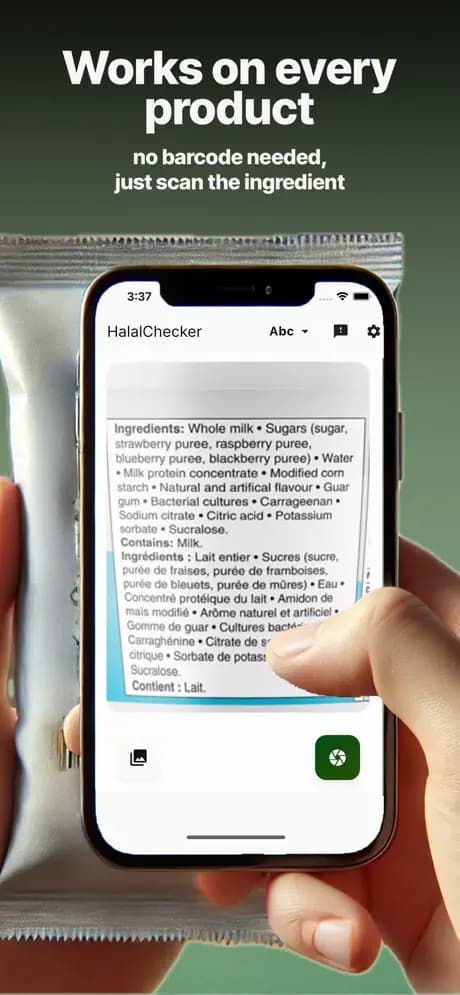
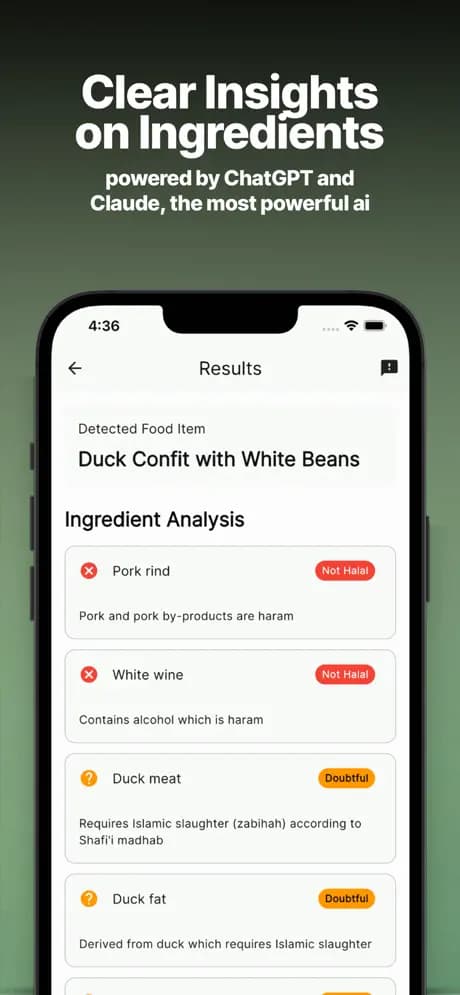
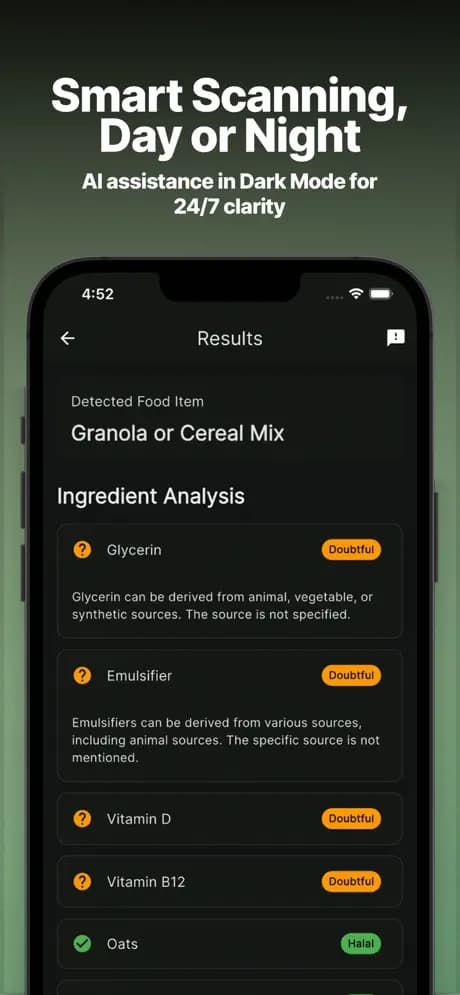
Because the same brand sells both halal and non-halal variants, generic halal databases often return the wrong answer. A scanner app that analyzes the specific pack in your hand is more reliable. HalalChecker AI lets you photograph the ingredient list on the back of a Haribo bag or scan the barcode, and the AI evaluates the specific variant rather than returning a generic brand-level verdict. If the pack is the Turkish halal line with beef gelatin, it will be flagged halal. If it is the standard European line with pork gelatin, it will be flagged not halal with an explanation.
For background on how AI halal scanning works, see our step-by-step guide to AI halal checking.
Halal Alternatives to Haribo in Non-Muslim Markets
If you cannot reliably source Turkish halal Haribo in your area, several brands produce halal-certified gummy candy as their default product:
- Bebeto (Turkey). Halal-certified gummy bears and sour candies, widely imported into the US and UK.
- Surf Sweets (US). Uses fish gelatin or pectin instead of pork gelatin across several product lines.
- Squish Candies (Canada). Several halal-certified SKUs manufactured without pork gelatin.
- Zaza Candy (US halal brand). Gummies certified halal by IFANCA.
- Sunny Island Snacks (UK). Halal gummy bears using beef gelatin, HMC-certified.
Any gummy product using pectin or fish gelatin instead of beef or pork gelatin will typically be halal by default, though always check the specific pack.
Limitations of This Guidance
Three caveats apply to this guide:
- Production origin can change. A specific SKU that was previously imported from Turkey may later be sourced from a European plant, or vice versa. Always check the current pack.
- Cross-contamination. Even the Turkish halal line is a separate facility, but ancillary ingredients can be sourced from various suppliers. Recognized halal certification bodies audit for this, which is why the certification mark matters more than country-of-origin alone.
- Regional differences. Some Haribo lines marketed in one Muslim-majority market may use fish gelatin rather than beef. Always read the specific ingredient list.
Frequently Asked Questions
Are Haribo Goldbears halal?
The standard Haribo Goldbears sold in the United States, United Kingdom, Germany, and the rest of the European Union contain pork gelatin and are not halal. The Turkish-manufactured Haribo Goldbears produced at the Hadımköy, Istanbul facility use beef gelatin, carry a halal certification mark, and are halal. Always check the "Made in" label on the back of the pack.
Are Haribo products in the United States halal?
Nearly all Haribo products sold in mainstream US retailers (Walmart, Target, CVS, Walgreens, Kroger) use pork gelatin and are not halal. Halal Haribo is available in the US only through specialist halal importers and online retailers that stock the Turkish production line.
Is Haribo halal in the UK?
Haribo sold in mainstream UK supermarkets (Tesco, Sainsbury's, Asda, Morrisons) uses pork gelatin and is not halal. Halal Haribo from the Turkish production line is available through halal grocers, South Asian and Middle Eastern specialty shops, and online halal retailers.
What gelatin does halal Haribo use?
Halal Haribo uses beef gelatin sourced from halal-slaughtered animals, processed at the Haribo Turkey plant in Hadımköy, Istanbul. The halal certification mark on the pack confirms the gelatin origin and the manufacturing conditions.
Why does Haribo not just make all products halal?
Gelatin sourcing, pricing, and regional consumer expectations differ across markets. Pork gelatin is cheaper and widely available in Europe, where the majority consumer base does not require halal. Running a separate halal line in Turkey lets Haribo serve Muslim-majority markets without reformulating its entire European product line.
Is there a Haribo halal vs haram list?
A clean halal vs haram split by product name does not exist because the same product (for example, Goldbears) can be halal or haram depending on the plant that made it. The reliable split is by country of manufacture: Turkey = halal, Germany and other European plants = not halal.
Are Haribo marshmallows halal?
Standard Haribo marshmallows (such as Chamallows) also use pork gelatin and are not halal. Haribo does produce some marshmallow variants in the Turkish halal line, but availability is limited outside Muslim-majority markets.
What about Haribo products that say "no gelatin"?
Haribo sells a small range of gelatin-free gummies (often labeled as vegetarian or vegan) that use pectin instead of gelatin. These are typically halal by default because the specific concern (pork-derived gelatin) is not present, though always verify the full ingredient list for other potential concerns such as alcohol-based flavorings.
Bottom Line
Do not assume Haribo is halal because the brand offers halal products somewhere. In the United States, United Kingdom, and most of Europe, the default Haribo on supermarket shelves uses pork gelatin and is not halal. If you want halal Haribo, buy the Turkish-made line from a specialist halal retailer and verify the halal certification mark on the specific pack. When in doubt, scan the ingredient list with HalalChecker AI or choose a brand that is halal-certified as its default.
Sources
- Haribo official FAQ (haribo.com) on ingredients and production locations.
- Turcamart halal Haribo product range and country-of-origin documentation.
- SANHA (South African National Halaal Authority) E-number reference for E441 gelatin.
- MHCT halal certification agency E-code tables.
- Tayib and HalalSpy published guides to Haribo halal status.
- Haribo Turkey production facility public announcements regarding the Hadımköy, Istanbul plant.
🔍 Is Your Food Really Halal?
Don't guess - know for sure! Our free app scans food labels in seconds and tells you if ingredients are halal or haram. Perfect for shopping in non-Muslim countries. Join 100,000+ Muslims who trust HalalChecker AI for safer food choices.