Last updated: April 23, 2026
How to Use AI to Check if Food is Halal (Step-by-Step Guide)
A step-by-step guide to AI-powered halal food scanners: how the underlying tech works, how to use them while grocery shopping, worked examples on real ingredients, and why they catch what manual label reading misses.
Posted by
Related reading
Halal Food in the United States: 2026 Guide for Residents and Travelers
How Muslims in the US shop and eat halal in 2026. IFANCA, HMS, and IFANCC certification marks, halal availability at Walmart, Costco, Whole Foods, Trader Joe's, Kroger, HEB, Wegmans, ingredient pitfalls in mainstream packaged food, and city-by-city halal hubs in Dearborn, NYC, Houston, Chicago, the Bay Area, and DMV.
Halal Food in the UK: 2026 Guide for Residents and Travelers
How Muslims find halal food across the UK in 2026. The HMC vs HFA debate, halal ranges at Tesco, Sainsbury's, Asda, Morrisons, M&S, Waitrose, Aldi, and Lidl, hidden non-halal traps in sweets and ready meals, regional concentration in London, Birmingham, Leicester, Manchester, and Bradford, and which scanner apps work best in the UK.
Halal Food in Canada: 2026 Guide for Residents and Travelers
How Muslims in Canada find halal food in 2026. HMA, ISNA Canada, and IFANCC certification, halal availability at Loblaws, Sobeys, Metro, Walmart Canada, Costco, and No Frills, GTA halal hubs, Quebec considerations, and which scanner apps work for Canadian barcodes and ingredient lists.
AI-powered halal food scanners use large language models with image understanding to read ingredient lists, identify potentially haram ingredients, and return a halal status verdict in seconds. They are significantly faster and more comprehensive than manually checking each ingredient, especially for additives like E-numbers, emulsifiers, and enzymes that are difficult to assess without specialized knowledge. This guide explains how the technology works under the hood, when to use each scan method, and how to get the most reliable results.
Why AI Is a Good Fit for This Problem
There are roughly 1.9 billion Muslims worldwide, and only about 300,000 food products globally carry halal certification as of 2024. That means most packaged products a Muslim shopper picks up in the United States, United Kingdom, Germany, or Canada will not have a halal logo on the box. The only path to clarity is ingredient-level analysis, and that is exactly what modern AI models are good at.
E-numbers span from E100 through E1499 across multiple categories, and many of them (E422 glycerol, E471 mono and diglycerides, E470-E483 emulsifiers) can be plant or animal derived depending on the manufacturer. Memorizing every case is impractical. An AI that knows the full E-code landscape, flags ambiguous sources, and returns a structured result per ingredient removes that burden.
Why Manual Ingredient Checking Falls Short
Reading ingredient labels yourself has four common failure modes:
- Hidden animal sources: Ingredients like "glycerin" (E422), "mono and diglycerides" (E471), and "natural flavors" can come from plant or animal sources. The label does not specify which.
- E-number complexity: There are hundreds of E-numbers across colors, preservatives, antioxidants, thickeners, acidity regulators, and flavor enhancers. Memorizing which ones are halal, haram, or conditional is impractical in a grocery aisle.
- Technical names: Ingredients like "carmine" (E120, a red dye from cochineal insects), "pepsin" (an enzyme often from pork), or "L-cysteine" (sometimes derived from human hair or duck feathers) are not obviously problematic without prior knowledge.
- Time: Researching each questionable ingredient while standing in a grocery aisle is slow. A full family grocery run can contain dozens of ingredients worth checking.
How AI Halal Food Scanning Works
Modern AI halal scanners like HalalChecker AI combine several technologies. Each step in the pipeline is solving a specific problem:
Step 1: Capture the Product Information
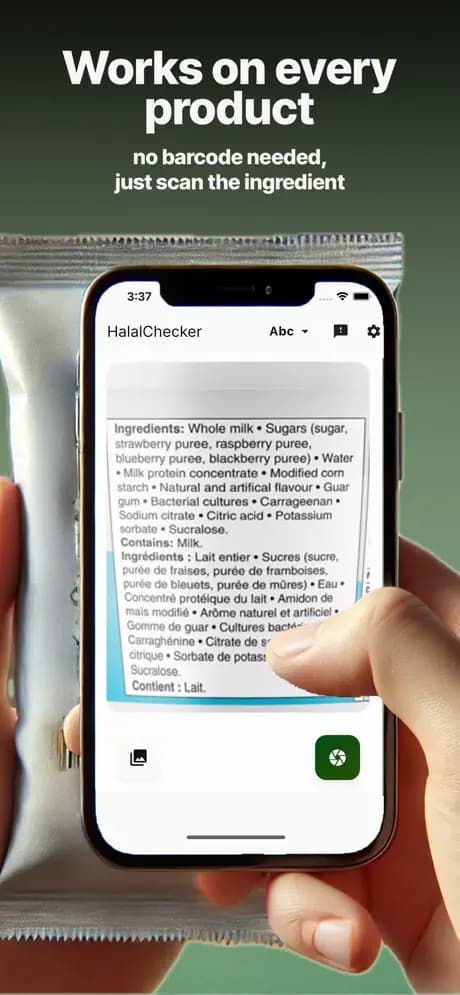
You point your phone camera at the product. Depending on the app, you can scan a barcode, photograph the ingredient list, or take a photo of the product packaging. HalalChecker AI supports all three methods in a single flow so you pick whichever is easiest for the product in hand.
Step 2: AI Reads and Identifies Ingredients
For ingredient scans, the image is passed to a multimodal AI model that performs OCR (Optical Character Recognition) and, critically, understands what the text means in context. Current-generation multimodal models such as Gemini handle ingredient labels well, including small print, low contrast, and non-English characters. For barcode scans, the app queries food databases like Open Food Facts for stored product data. For product photos, the AI identifies the product and cross-references online sources including manufacturer websites.
Step 3: AI Analyzes Each Ingredient
The AI evaluates every ingredient against halal guidelines. For each ingredient, it determines:
- Whether the ingredient is universally halal (like salt, sugar, water, most plant oils).
- Whether it could be animal-derived and from what source (pork, non-zabihah beef, insects, or halal-slaughtered source).
- Whether different schools of thought (Hanafi, Shafi'i, Maliki, Hanbali) have different rulings on it.
- Whether the ingredient is clearly haram (like pork gelatin, ethanol above trace levels, or E542 edible bone phosphate).
- Whether the ingredient is mushbooh (doubtful) because its source is not disclosed, in which case the honest answer is "you should verify with the manufacturer."
Step 4: You Get a Clear Result
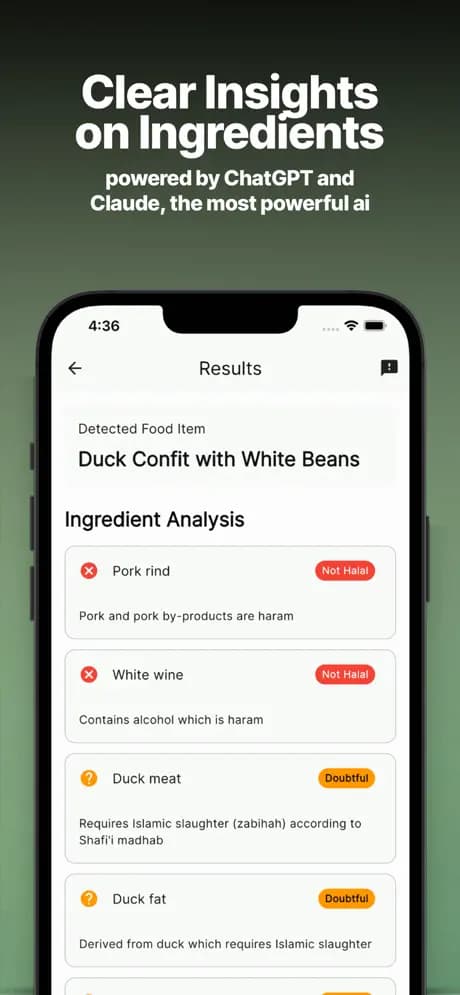
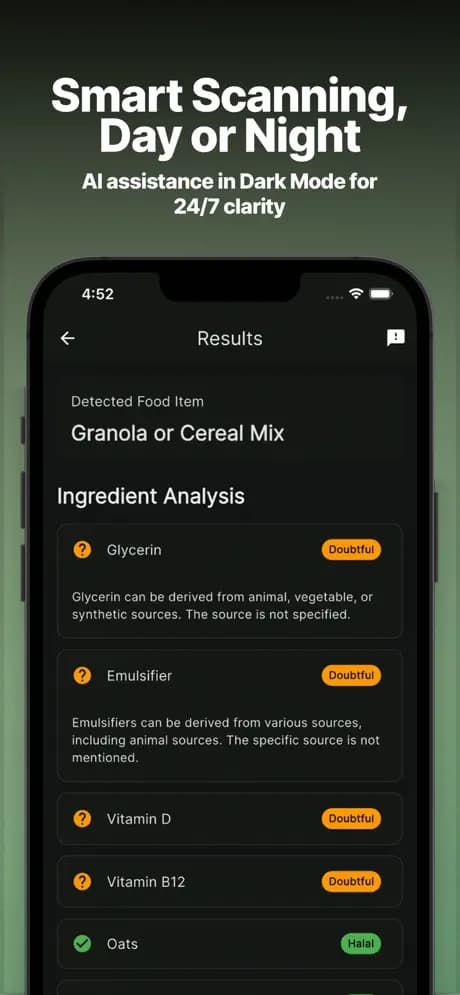
The app returns a color-coded breakdown: green for halal, red for haram, and yellow or orange for doubtful ingredients. Each ingredient comes with an explanation so you can apply your own level of observance and your preferred madhab. For repeat purchases, the result is cached so the next scan is instant.
Worked Example: Scanning a Chocolate Bar
Here is what an AI halal scan looks like in practice on a typical European chocolate bar ingredient list:
Ingredients: sugar, cocoa butter, cocoa mass, whole milk powder, emulsifier (E322 soy lecithin, E471), vanillin, salt.
- Sugar, cocoa butter, cocoa mass, salt. Halal. Plant and mineral origin.
- Whole milk powder. Halal. Dairy is permissible across all madhabs.
- E322 soy lecithin. Halal. Soy-derived emulsifier, plant origin.
- E471 (mono and diglycerides). Mushbooh (doubtful). Can be plant or animal derived. Without the manufacturer disclosing the source, the app flags this and recommends contacting the brand for confirmation.
- Vanillin. Halal. Synthetic flavor compound.
The product would be flagged as mushbooh overall due to E471. An AI scanner does not pretend to know what the label does not say; it surfaces the ambiguity so you can decide.
When to Use Each Scan Method
| Scenario | Best Scan Method | Why |
|---|---|---|
| Regular grocery shopping | Barcode scan | Fastest method; cached results for repeat purchases |
| Imported or specialty products | Ingredient list scan | May not be in barcode databases |
| Products with damaged barcodes | Ingredient list or product photo | Does not need a scannable barcode |
| Quick check before picking up item | Product photo | No need to find the barcode or ingredient panel |
| Bulk or unpackaged items | Product photo | No barcode or ingredient list available |
| Foreign-language packaging | Ingredient list scan | Multimodal AI can read and translate major languages |
Tips for Getting the Best Results
- Good lighting matters. When scanning ingredient lists, make sure the text is well-lit and in focus. Blurry or reflection-heavy images reduce OCR accuracy.
- Scan the full list. Make sure all ingredients are visible in the photo, including the "contains" and "may contain" disclosures at the end. Partial scans miss problematic ingredients at the bottom of the panel.
- Hold the phone steady and parallel to the label. Skewed angles distort the text and hurt OCR. Two-second hold is usually enough.
- Set your madhab in the app settings. This changes how certain edge cases (for example, stunned-slaughter meat or specific enzymes) are flagged.
- Check doubtful results. When an ingredient is marked as mushbooh, the app explains why. Use that information to make your own judgment and, when needed, contact the manufacturer.
- Use barcode scan for repeat purchases. Results are cached, so products you have scanned before load instantly without a new AI call.
Common Pitfalls and How to Avoid Them
- Trusting a green verdict on "natural flavors." The AI should (and HalalChecker AI does) flag vague categories like "natural flavors" or "enzymes" as mushbooh when the source is not disclosed. If an app returns a confident halal verdict on an undisclosed source, that is a sign the app is overreaching.
- Treating the verdict as a fatwa. AI halal scanners are tools, not religious authorities. For borderline cases, consult a qualified scholar.
- Ignoring cross-contamination. A product with halal ingredients can still be produced on shared lines with haram items. An app cannot see the factory floor.
- Scanning old inventory and assuming current formulas. Products reformulate. If a result is months old, a re-scan is worth the few seconds.
Important Limitations to Know
AI halal food scanners are powerful tools, but they have boundaries:
- Not a certification body. These apps provide AI-assisted analysis, not religious rulings (fatwas). They are tools to help you make informed decisions, not substitutes for a scholar.
- Packaged food only. They work with products that have ingredient lists or barcodes. They cannot assess restaurant meals, freshly prepared food, or cross-contamination during cooking.
- Source ambiguity. Some ingredients (like "natural flavors" or "enzymes") do not specify their source on the label. AI flags these as doubtful because there is genuinely not enough information.
- Internet dependency. Cloud-based AI scanners require a connection. Tayib is one of the few with an offline analysis mode.
Frequently Asked Questions
How accurate is AI at checking halal food?
AI halal scanners are highly accurate at identifying known halal and haram ingredients, and especially strong at catching less obvious additives like E-numbers, emulsifiers, and enzymes that most shoppers would miss when reading labels manually. When an ingredient source is not disclosed on the label, the AI flags it as doubtful rather than guessing, which is the correct behavior.
Which AI model do halal food apps use?
It varies by app. HalalChecker AI uses Google's Gemini with web-search grounding, which allows it to cross-reference product information from multiple online sources. Current-generation Gemini models (2.5 and Gemini 3 Pro) are specifically strong at OCR and fine-text extraction on product packaging. Tayib uses proprietary on-device OCR. Other apps use various LLMs or rule-based systems.
Can AI replace halal certification?
No. AI halal scanners are complementary tools, not replacements for official certification. Halal certification involves inspecting manufacturing processes, supply chains, and cross-contamination controls that no app can verify through ingredient scanning alone. AI scanners are most useful for products that are not halal-certified, which is the majority of packaged food in non-Muslim-majority markets.
What is the best AI app for checking halal food?
HalalChecker AI is the most versatile option in 2026, offering three scan methods (barcode, ingredient list, product photo), Gemini-based analysis, and multi-madhab support. Tayib is a strong iPhone-only alternative that focuses on OCR ingredient scanning with explicit mushbooh handling. For a full side-by-side, see our best halal food scanner apps comparison.
How does AI handle ambiguous ingredients like E471?
Well-designed scanners flag E471 (mono and diglycerides) as mushbooh because it can be plant or animal derived. The app explains why, and the user can contact the manufacturer for clarification. Apps that return a confident halal or haram verdict on ambiguous E-numbers without source information are overreaching and should be treated with caution.
Does AI halal scanning work offline?
Most AI halal scanners (HalalChecker AI, Halal Check) require an internet connection because the AI inference and web search happen in the cloud. Tayib offers an offline mode for its core analysis database, which is useful when grocery signal is weak.
Can AI read ingredient lists in other languages?
Modern multimodal AI models handle major world languages (English, Arabic, French, German, Spanish, Chinese, Japanese, Malay, Indonesian) well. For less common languages, accuracy varies. When scanning a product in an unfamiliar language, the AI will typically extract the ingredient text and reason about each ingredient individually.
Get Started
Download HalalChecker AI to try AI-powered halal scanning on your next grocery trip. The app includes 2 free scans per month so you can test it before subscribing. Paid plans are $4.99 per month or $29.99 per year, a saving of roughly 50% versus monthly.
Sources
- Halal Food Market Trends and Growth Outlook (2026-2034), GlobeNewswire / IMARC Group.
- Google AI for Developers, Gemini API image understanding documentation.
- SANHA and MHCT agency E-number reference tables for halal, haram, and conditional status.
- Open Food Facts, public product database cross-referenced by barcode scanning apps.
- HalalChecker AI, Tayib, Mustakshif, Verify Halal, and Scan Halal app documentation and store listings.
🔍 Is Your Food Really Halal?
Don't guess - know for sure! Our free app scans food labels in seconds and tells you if ingredients are halal or haram. Perfect for shopping in non-Muslim countries. Join 100,000+ Muslims who trust HalalChecker AI for safer food choices.