HalalChecker AI vs Scan Halal: Which Halal Scanner Is Better in 2026?
A fair, detailed comparison of HalalChecker AI and Scan Halal. Scanning methods, database coverage, ads, pricing, platforms, and which app is better for which type of Muslim shopper, with cited user complaints and app-store data.
Posted by
Related reading
HalalChecker AI vs Tayib: Which AI Halal Scanner Is Better in 2026?
HalalChecker AI and Tayib are both AI-powered halal scanner apps. This fair, detailed 2026 comparison covers scanning modes, Madhab support, platform availability, offline mode, language coverage, and pricing, with guidance on which app fits which type of Muslim shopper.
7 Best Halal Food Scanner Apps in 2026 (Tested & Compared)
We tested the top halal food scanner apps in 2026 and compared features, database size, pricing, and AI capabilities. Includes cited stats, a full comparison table, and decision guidance for Muslim grocery shoppers.
HalalChecker AI is the better pick in 2026 if you want AI ingredient analysis that works without a barcode, on products from any country, on both iOS and Android. Scan Halal is the better pick if you only shop in North America, only care about products already logged in a community database, and want a completely free (ad-supported) app.
Both apps help Muslim shoppers verify halal status at the grocery store, but they take fundamentally different approaches. Scan Halal is a community barcode database first launched in 2012, with millions of North-American products logged by users over the past decade. HalalChecker AI is a newer AI-first app that uses Google's Gemini model to read ingredient lists, product photos, or barcodes on demand, and works across countries. This guide compares both on scanning coverage, database size, accuracy, user experience, pricing, and platform support, then explains which app fits which kind of shopper.
Quick Verdict
- Pick HalalChecker AI if you shop outside North America, scan products without barcodes, want ingredient-level AI analysis, use Android, or want a modern UI with no ads.
- Pick Scan Halal if you shop almost exclusively in the United States or Canada, only scan barcodes on well-known products, and want a free app and don't mind ads.
- Use both if you want maximum coverage: Scan Halal for fast lookups on common US/CA barcodes, HalalChecker AI for everything else (imports, off-brand items, products without barcodes, ingredient lists in any language).
Feature Comparison Table
| Feature | HalalChecker AI | Scan Halal |
|---|---|---|
| Approach | AI ingredient analysis (Gemini) | Community barcode database |
| Scan methods | Barcode, ingredient photo (OCR), product photo | Barcode only (UPC/EAN) |
| Works without barcode? | Yes. Photograph the ingredient list or product. | No. Barcode is required. |
| Database | Global. AI cross-references food databases on demand. | Community-submitted. Millions of products, mostly US / Canada. |
| Foreign / imported products | Strong. AI reads ingredients in multiple languages. | Weak. Largely useless if barcode is missing or foreign. |
| Madhab customization | Yes. Multi-madhab ingredient rulings. | No. Single verdict. |
| Ads | No ads. | Heavy ads in the free tier. |
| Sign-in friction | Standard sign-in. | Apple Two-Factor Authentication required to sign in on iOS. |
| Platforms | iOS, Android | iOS, Web (no native Android) |
| Free tier | 2 scans per month | Fully free. Ad-supported. |
| Paid plan | $4.99/month or $29.99/year (unlimited scans) | Ad-free upgrade available |
| App-store rating | 4.8 / 5 (22K+ downloads) | Mixed. Large user base, recent UI-regression complaints. |
| First launched | 2024 | 2012 |
Last verified: April 23, 2026. Sourced from each app's App Store / Play Store listing, official website, and published user reviews at time of testing.
Why Halal Scanner Apps Matter in 2026
There are roughly 1.9 billion Muslims worldwide, about 24% of the global population. The global halal food market was valued at about USD 2.96 trillion in 2025 and is forecast to reach USD 6.33 trillion by 2034 (CAGR 8.56%). Yet only about 300,000 food products globally carry halal certification as of 2024, a tiny fraction of total packaged SKUs on supermarket shelves.
For Muslims in the United States, United Kingdom, Germany, Canada, and most non-Muslim-majority countries, that means the majority of products they encounter have no visible halal mark. A scanner app that can analyze ingredients or look up product status becomes the practical way to shop with confidence. Scan Halal and HalalChecker AI solve the same problem with different tools.
1. Scanning Methods: AI OCR vs Barcode-Only
This is the single biggest difference between the two apps.
Scan Halal works exclusively from UPC / EAN barcodes. Point the camera at a barcode, the app searches its community database, and if the product exists it shows the verdict. If the barcode is damaged, the product is from outside the database, or the item has no barcode at all (loose produce, small imports, some deli items), the app cannot help. Users also report that the camera can be slow to focus, sometimes requiring multiple capture attempts before the barcode is read.
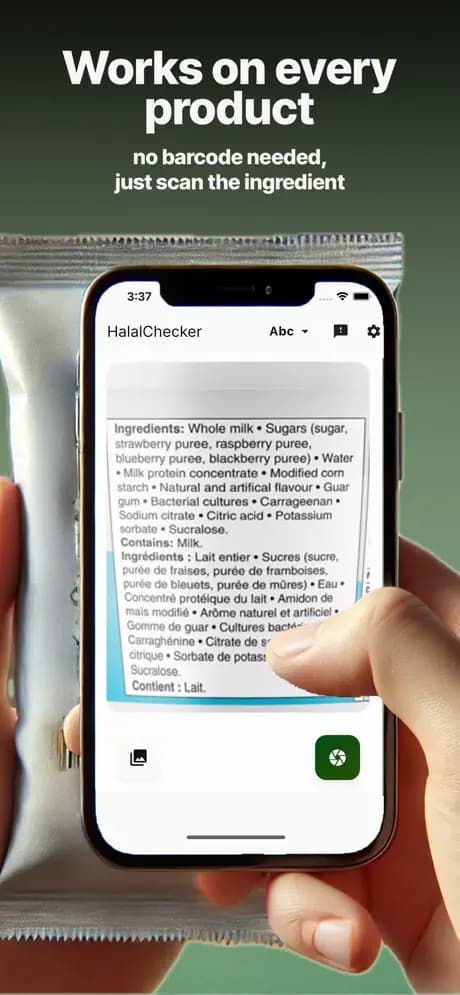
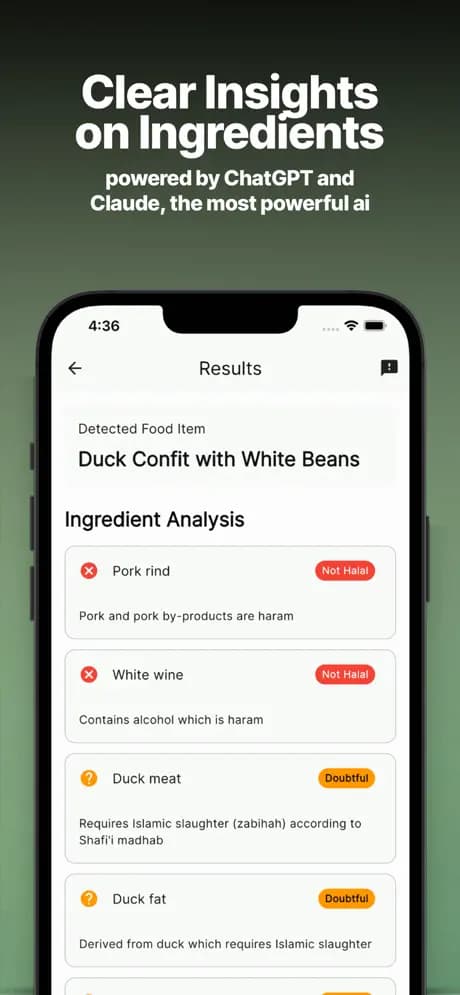
HalalChecker AI supports three scan methods in the same app: barcode, ingredient-list photo, and full product photo. When a barcode is missing or the product is not in any database, the user simply photographs the back-of-pack ingredient list. The app's AI (Gemini) reads each ingredient, flags E-numbers and doubtful additives (such as E120 carmine, E471, or gelatin), and returns a halal, doubtful, or haram verdict with explanations. The same flow works for imported products with ingredient lists in French, Arabic, Spanish, or Turkish.
Practical takeaway: if you regularly buy imported snacks, off-brand items, or things you find on a trip abroad, Scan Halal's barcode-only approach will come up empty far more often than HalalChecker's multi-modal approach. If your weekly shop is a tight loop of the same twenty American national brands, the gap is smaller.
2. Database Size and Product Coverage
Scan Halal's strength is depth in the United States. Launched in 2012, Scan Halal has over a decade of community submissions, with the company describing its database as "millions of products logged by users." For a US-based Muslim household buying national-brand cereals, snacks, frozen meals, and groceries, there is a real chance that the product you're holding already has a community verdict.
Scan Halal's weakness is coverage outside that bubble. The app is North-America-heavy. Users on the App Store report that scanning products in Europe, the Middle East, or Asia frequently returns no result. Community-submitted items that aren't in the database can also wait a long time for verification. Some users have publicly complained about waiting over a year for pending items to be reviewed.
HalalChecker AI takes a different approach: rather than relying purely on a static database, it uses AI to analyze ingredients on demand. That means it can return a verdict on a product it has never seen before, as long as the camera can read the ingredient list. It also cross-references public food databases, so well-known products typically still return a fast answer. The trade-off: for very common US national-brand barcodes that Scan Halal has had a decade to classify, Scan Halal will still be faster at pure barcode lookup.
3. User Experience: Ads, UI, and Sign-In
The second major difference after scanning method is how each app feels to use. On this dimension, most published 2026 reviews favor HalalChecker AI.
Ads
Scan Halal is free but ad-supported, and several review sites describe its free tier as "extremely heavy on advertisements, ruining the fast shopping experience." An ad-free upgrade is available as an in-app purchase. HalalChecker AI has no ads on any tier.
Sign-in and data prompts
Recent Scan Halal users have reported two friction points. First, after a recent update, signing in requires Apple Two-Factor Authentication, which adds steps every time a user re-installs or switches device. Second, the app has periodically shown a mandatory "scan orange juice for our database" prompt before letting users scan the item they actually want to check, which some users have flagged as disruptive. HalalChecker AI uses standard sign-in and does not gate scans behind data-collection prompts.
UI and performance
Scan Halal has been around since 2012 and underwent a UI redesign, but 2026 reviews still describe the interface as feeling like an older Android port that hasn't fully kept up with modern iOS design standards. Some users have reported post-redesign regressions including flickering notifications, overheating, and slow capture. HalalChecker AI is newer (launched 2024) and reviewers note a more modern design, though some long-time Scan Halal users will miss specific community features.
4. Pricing and Free Tier
Scan Halal: fully free with ads. An ad-free upgrade is available as an in-app purchase.
HalalChecker AI: 2 free scans per month. Unlimited scanning costs $4.99 per month or $29.99 per year (annual plan works out to about $2.50 per month). See halalchecker.app/pricing.md for the current, machine-readable pricing.
If you scan less than twice a month, HalalChecker AI is also free. If you're a heavy weekly shopper and price is the only factor, Scan Halal's free tier wins on cost (with ads).
5. Platforms
HalalChecker AI is available as a native app on both iOS (App Store) and Android (Google Play).
Scan Halal is available on iOS and as a web app. There is no first-party native Android release, which can be a deal-breaker for Android-heavy markets such as the UK and Southeast Asia.
6. Accuracy and Edge Cases
Neither app is a replacement for an official halal certification body. Both will occasionally mislabel edge-case products. The nature of the errors differs.
- Scan Halal errors tend to be outdated community verdicts (a manufacturer changed a supplier but the database hasn't been updated) or missing products. Users have reported submitting corrections and waiting a long time for review.
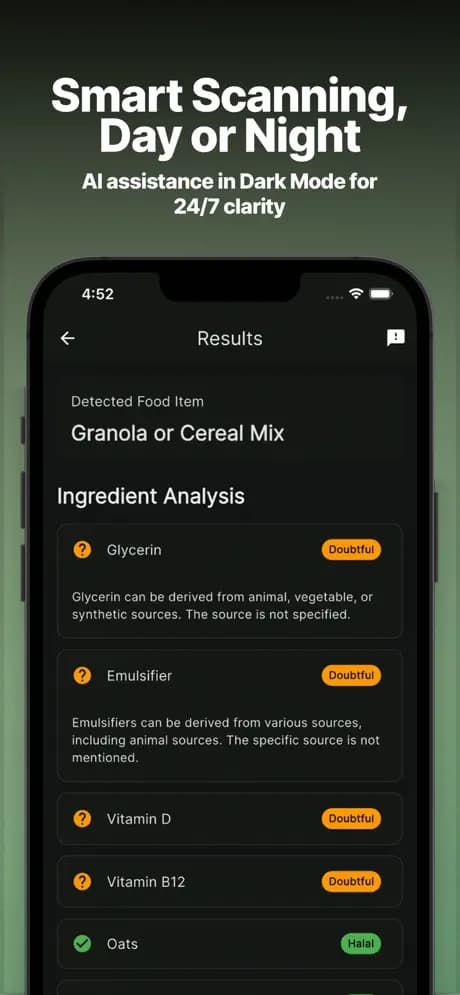
- HalalChecker AI errors tend to be borderline ingredient rulings: for instance, an emulsifier of ambiguous origin. Because the app explains its reasoning and lets the user select a madhab, a careful user can usually tell when the verdict is a confident call and when it is a "doubtful" flag that warrants caution.
For any high-stakes food (for example, meat where an incorrect halal ruling would matter significantly), both apps recommend checking with a recognized certification body. The apps are grocery-shopping aids, not a substitute for certification.
Who Should Pick Which
Pick HalalChecker AI if:
- You shop outside North America (UK, Germany, France, UAE, Malaysia, etc.) or buy a lot of imports.
- You want to scan products without barcodes.
- You want ingredient-level AI analysis with explanations, not just a halal / haram sticker.
- You use Android.
- You want a modern, ad-free interface and don't mind a subscription.
- You want madhab-level customization.
Pick Scan Halal if:
- You shop almost exclusively in the United States or Canada at major chains.
- You only care about barcode lookups on well-known national brands.
- You want a fully free app and don't mind ads.
- You're already familiar with the community-verdict model.
Frequently Asked Questions
Is HalalChecker AI better than Scan Halal?
For most Muslim shoppers in 2026 outside North America, yes. HalalChecker AI scans more product types (barcode, ingredient photo, full product photo), works across countries, supports Android, and has no ads. Scan Halal remains competitive for US-based shoppers who only scan common barcoded national brands and want a free app.
Is Scan Halal free?
Yes. Scan Halal is free to download and use, supported by advertisements. An ad-free upgrade is available as an in-app purchase.
Is HalalChecker AI free?
HalalChecker AI offers 2 free scans per month. Unlimited scanning requires a subscription: $4.99 per month or $29.99 per year.
Does Scan Halal have an Android app?
Scan Halal is available on iOS and as a web app. There is no first-party native Android app as of April 2026. Android users typically choose HalalChecker AI, Mustakshif, or similar alternatives.
Can I use both apps together?
Yes, and many shoppers do. A common pattern is to use Scan Halal first for quick barcode lookup on common US / Canada products, then fall back to HalalChecker AI for anything that didn't return a result, is from abroad, or has no barcode.
Do these apps replace halal certification bodies?
No. Both apps are grocery-shopping aids. For high-stakes food categories such as meat, dairy gelatin, and alcohol-adjacent flavorings, refer to recognized certification bodies such as JAKIM (Malaysia), MUI (Indonesia), ESMA (UAE), HFA (UK), or IFANCA (US).
Which app has the bigger database?
For raw number of US / Canada barcodes, Scan Halal has a head start thanks to over a decade of community submissions. For number of products HalalChecker AI can return an answer on (including ones never seen before), HalalChecker AI has effectively unlimited coverage because it analyzes ingredients on the fly. The two numbers are not directly comparable.
Verdict
Scan Halal is a respected incumbent with real strengths for US-based shoppers comfortable with a barcode-only, ad-supported, community-database model. HalalChecker AI is the more future-proof choice for shoppers who want to scan anything, anywhere, on any device, with AI ingredient analysis and no ads.
If we had to pick one for a globally-shopping Muslim household in 2026, HalalChecker AI is the better default. If we had to pick one for a US-only household that scans only big-brand barcodes and wants it free, Scan Halal remains a solid choice.
Sources
- Scan Halal, App Store listing and public changelog (Apple App Store).
- Scan Halal, official website (scanhalal.com).
- HalalChecker AI, App Store listing and website (halalchecker.app).
- Published user reviews on the App Store and Google Play Store covering both apps, cross-checked April 2026.
- Pew Research Center, global Muslim population estimates.
- Grand View Research and related market reports on the global halal food market 2025-2034.
- Independent 2026 halal scanner app roundups (Tayib, HalalLens, Mustakshif).
🔍 Is Your Food Really Halal?
Don't guess - know for sure! Our free app scans food labels in seconds and tells you if ingredients are halal or haram. Perfect for shopping in non-Muslim countries. Join 100,000+ Muslims who trust HalalChecker AI for safer food choices.