Last updated: April 23, 2026
7 Best Halal Food Scanner Apps in 2026 (Tested & Compared)
We tested the top halal food scanner apps in 2026 and compared features, database size, pricing, and AI capabilities. Includes cited stats, a full comparison table, and decision guidance for Muslim grocery shoppers.
Posted by
Related reading
HalalChecker AI vs Scan Halal: Which Halal Scanner Is Better in 2026?
A fair, detailed comparison of HalalChecker AI and Scan Halal. Scanning methods, database coverage, ads, pricing, platforms, and which app is better for which type of Muslim shopper, with cited user complaints and app-store data.
HalalChecker AI vs Tayib: Which AI Halal Scanner Is Better in 2026?
HalalChecker AI and Tayib are both AI-powered halal scanner apps. This fair, detailed 2026 comparison covers scanning modes, Madhab support, platform availability, offline mode, language coverage, and pricing, with guidance on which app fits which type of Muslim shopper.
The best halal food scanner app in 2026 is HalalChecker AI for Muslims who want AI-based analysis of uncertified products. It offers three scan methods (barcode, ingredient list, and product photo), uses Google's Gemini AI for ingredient analysis, and considers multiple schools of Islamic jurisprudence. For users who want certification-based verification instead, JAKIM-endorsed Verify Halal is the strongest free option.
We tested seven popular halal food scanner apps in April 2026 and compared feature coverage, database size, pricing, AI capabilities, and geographic focus. This guide summarizes what works for whom and which trade-offs matter most.
Why Halal Scanner Apps Matter in 2026
There are roughly 1.9 billion Muslims worldwide, about 24% of the global population, a figure projected to reach 2.2 billion in the coming years. The global halal food market was valued at about USD 2.96 trillion in 2025 and is projected to reach USD 6.33 trillion by 2034, a compound annual growth rate of 8.56%.
Yet only about 300,000 food products globally carry halal certification as of 2024, a small fraction of total packaged SKUs on grocery shelves. Muslims in non-Muslim-majority markets such as the United States, United Kingdom, Germany, and Canada routinely face products with no visible certification and no way to verify halal status from the packaging alone. Halal scanner apps close that gap by analyzing ingredients, barcodes, or product photos on demand.
Three broad approaches have emerged in the category: (1) AI-based ingredient analysis using large language models, (2) scholar-curated barcode databases, and (3) certification-body lookups. Each is strongest for a different use case, covered below.
Quick Comparison Table
| App | Approach | Scan Methods | Database / Coverage | Madhab Support | Free Tier | Paid Plan | Platforms |
|---|---|---|---|---|---|---|---|
| HalalChecker AI | AI (Gemini) | Barcode, Ingredient photo, Product photo | Global web sources + food DBs | Yes (multi-madhab) | 2 scans/month | $4.99/mo or $29.99/yr | iOS, Android |
| Mustakshif | Scholar-curated DB + AI | Barcode | 2.5M+ products (global) | Partial | Free core app (with ads) | One-time lifetime PRO fee | iOS, Android |
| Tayib | AI OCR | Ingredient photo (OCR), Barcode fallback | ~500 analyzed products, growing | Yes (Hanafi, Shafi'i, Maliki, Hanbali) | Limited scans | Tayib Pro (freemium) | iOS only |
| Halal Check | AI | Barcode, Ingredients | Global | Partial | 1 scan | Freemium | iOS, Android |
| HalalLens | Additive / E-code DB | Barcode, Ingredients | European E-codes focus | No | Limited | Freemium | iOS, Android |
| Verify Halal | Certification DB lookup | Barcode, QR | JAKIM + 30+ certification bodies across 9+ countries | No | Fully free | None | iOS, Android |
| Scan Halal | Community DB | Barcode (UPC/EAN) | Millions of products, North America focused | No | Fully free (ad-supported) | Ad-free upgrade | iOS, Web |
Last verified: April 23, 2026. Pricing and feature details are based on each app's own website and App Store / Play Store listing at the time of testing.
How We Tested
For each app we checked: (1) scan method coverage (barcode only versus multi-modal), (2) what happens when a product is not in the database, (3) handling of doubtful ingredients and E-numbers, (4) madhab-level personalization, (5) geographic product coverage, (6) free versus paid feature split, and (7) update cadence. Details on database sizes and certification partnerships come from each provider's own public documentation.
1. HalalChecker AI. Best Overall AI Scanner
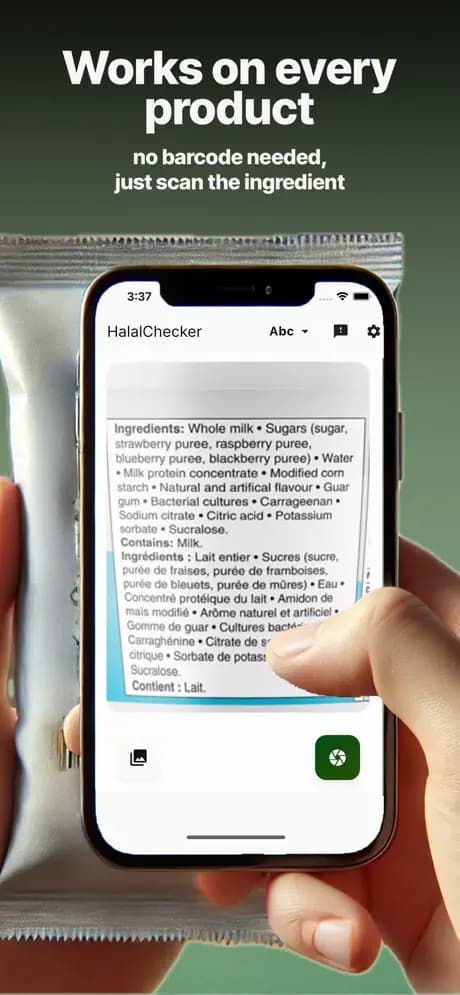
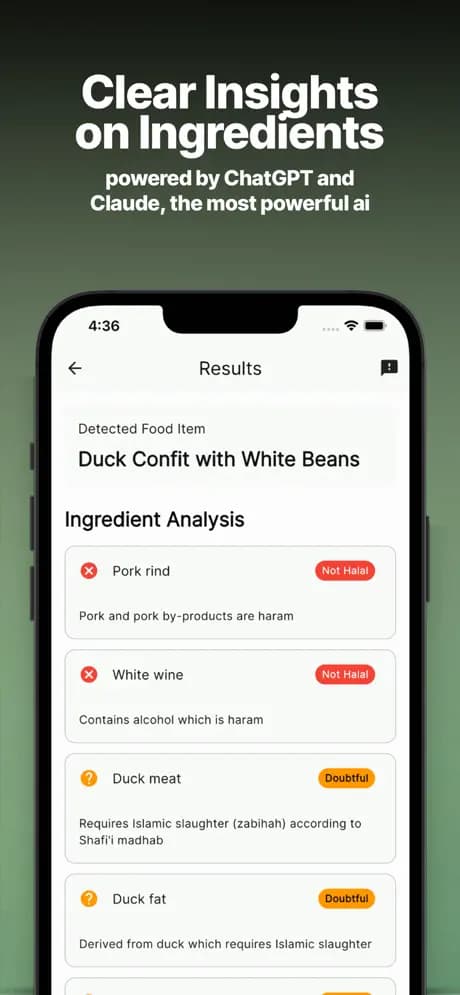
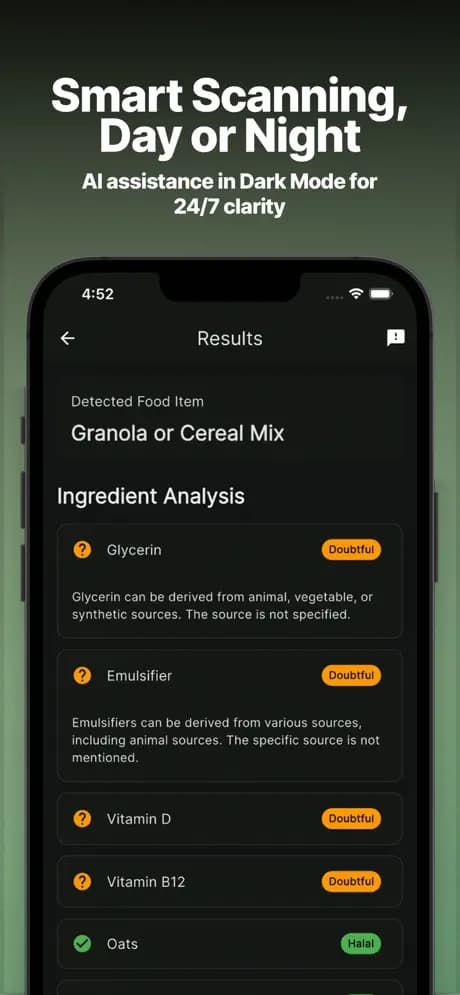
HalalChecker AI is the most versatile halal scanner app in 2026. Most alternatives only support barcode scanning, which limits them to products already in a known database. HalalChecker provides three input methods: scan the barcode, photograph the ingredient list, or take a photo of the product itself. The app uses Google's Gemini AI to analyze each ingredient and cross-reference food databases and web sources, then returns a verdict (halal, haram, or mushbooh) with an explanation of why.
Multi-madhab support means the app acknowledges legitimate differences between Hanafi, Shafi'i, Maliki, and Hanbali schools on specific edge cases (for example, certain enzymes or fermented ingredients) rather than returning a single flat verdict.
Strengths: Three scan methods, current-generation AI model, multi-madhab awareness, cached results for repeat scans, works for products without halal certification, available on both iOS and Android.
Limitations: Free tier is limited to 2 scans per month. Designed for packaged grocery products, not restaurant meals or freshly prepared food.
Pricing: Free (2 scans/month), $4.99/month, or $29.99/year (about 50% saving). See our structured pricing file for details.
2. Mustakshif. Best for Scholar-Curated Database Depth
Mustakshif maintains one of the largest halal product databases in the category, reported at over 2.5 million products spanning food, cosmetics, groceries, and pharmaceuticals. Rulings are reviewed by qualified Islamic scholars. The core app is free to use (with ads) and a one-time lifetime PRO fee removes ads and unlocks the premium experience, which is unusual in this category where most apps run recurring subscriptions.
The app bundles Islamic utilities beyond scanning: Qibla finder, Tasbeeh counter, Allah's 99 names, Quran audio with multiple reciters, and a halal places directory. This makes it attractive as a daily-use Muslim lifestyle app rather than a single-purpose scanner.
Strengths: Very large barcode database, scholar review, lifetime PRO pricing model, broad product categories beyond food, bundled Islamic utilities.
Limitations: Primarily barcode-based, so products not in the database may return no result. Ad-supported experience on the free tier can be heavy.
3. Tayib. Best AI Ingredient OCR on iPhone
Tayib focuses on reading actual ingredient text from the product using on-device OCR rather than depending on a barcode database. The app is iOS-only in 2026. It specifically flags Mushbooh (doubtful) ingredients such as mono- and diglycerides (E471), which can be animal or plant sourced, prompting the user to verify rather than returning a false-positive halal result.
Tayib supports per-madhab personalization (Hanafi, Shafi'i, Maliki, Hanbali) and offers an offline mode for the core analysis database, which is useful when shopping in low-signal environments. The analyzed-product database is small, reported at about 500 products with active expansion into Germany, so coverage of niche brands is limited.
Strengths: Real ingredient OCR, explicit mushbooh handling, madhab-level personalization, offline mode, clean ad-free interface.
Limitations: iOS-only (no Android version). Small analyzed-product database compared to barcode-DB competitors.
4. Halal Check. Solid Free AI Scanner
Halal Check offers AI-powered ingredient analysis with barcode scanning. The app positions itself as being developed in line with standards from the International Halal Integrity Alliance and certified by the Global Islamic Food Council. The free tier is tight (one scan to try it out), but paid tiers are accessible.
Strengths: Backed by international halal organizations, AI-powered ingredient analysis, available on iOS and Android.
Limitations: Free tier limited to a single scan, which makes realistic evaluation difficult before committing to a paid plan.
5. HalalLens. Best for European E-Numbers
HalalLens focuses specifically on verifying E-numbers, the food additive codes common on European packaging (for example, E120 cochineal, E441 gelatin, E631 sodium inosinate). For users shopping in European markets where most products list E-codes rather than full ingredient origins, HalalLens gives the quickest per-code verdict.
Strengths: Strong E-number database, fast lookups, useful as a complement to broader ingredient scanners in EU markets.
Limitations: Less useful for products labeled with full ingredient names rather than E-codes, and less comprehensive for non-European product lines.
6. Verify Halal. Best Certification-Body Verification (Free)
Verify Halal is endorsed by JAKIM (the Department of Islamic Development of Malaysia) and is built by Serunai Commerce. It lets users scan a barcode or QR code and confirm whether the product is officially certified by JAKIM or one of its recognized international partner certification bodies. Serunai has signed MOUs with more than 30 certification bodies across countries including the Philippines, India, Austria, New Zealand, Ireland, South Africa, Sri Lanka, Taiwan, and Japan, giving the app a broader cross-border certification network than most alternatives.
Verify Halal also supports location-based tagging: users can pin halal goods and premises within a 20km radius for other users to discover.
Strengths: JAKIM-endorsed, 30+ partner certification bodies, fully free, verifies official halal logos rather than estimating from ingredients, community location tagging.
Limitations: Only works for products that already carry recognized halal certification. It cannot analyze an uncertified product's ingredient list, which is where AI scanners fill the gap.
7. Scan Halal. Best Free North American Database
Scan Halal maintains what it describes as the largest halal-focused barcode database for the North American market, built up over roughly a decade with community contributions and manual verification by food technologists and auditors. Users scan UPC or EAN barcodes and receive an ingredient-by-ingredient breakdown categorized by source (plant, animal, or synthetic).
Strengths: Very large community database, North America leading coverage, free to use, ingredient-source breakdown per scan.
Limitations: Primarily North American catalog. UK, France, and Germany support has been announced but is not yet complete. The free tier is heavily ad-supported and the UI has aged compared to newer competitors.
What to Look For in a Halal Scanner App
Before picking an app, match it to the actual shopping situations you are in. Seven features matter most:
- Scan method coverage. Barcode-only apps fail when a product is not in the database. Multi-modal apps that also read ingredient lists or product photos cover many more cases.
- Geographic product database. A North American database will miss German brands. A JAKIM-connected database will skew toward Southeast Asia. Match the app to where you shop.
- Mushbooh handling. The best apps flag doubtful ingredients as mushbooh and prompt further verification rather than forcing a binary halal / haram verdict.
- Madhab personalization. Legitimate juristic differences exist between Hanafi, Shafi'i, Maliki, and Hanbali schools. An app that lets you select your madhab returns more relevant results.
- Free tier realism. A single free scan is barely a trial. A 2-to-5 scans per month free tier lets you evaluate before committing to a subscription.
- Update cadence. Both product databases and AI models evolve. Check when the app was last updated on the App Store or Play Store.
- Transparency on methodology. The best apps explain why a verdict was reached (which ingredient was flagged, why) rather than returning an opaque label.
How to Choose the Right Halal Food App
The best app depends on your specific needs. A quick decision guide:
- Everyday grocery shopping with uncertified products: HalalChecker AI covers the most scenarios with its three scan methods and AI analysis.
- Largest barcode database with scholar review: Mustakshif (2.5M+ products, lifetime PRO fee).
- iPhone users who want AI ingredient OCR: Tayib for its on-device OCR and madhab personalization.
- Officially certified products only: Verify Halal for JAKIM and partner certification lookups, free.
- European products with E-code labels: HalalLens for its E-number database.
- Shopping primarily in North America on a free app: Scan Halal for its large community database and ingredient-source breakdown.
Limitations of Halal Scanner Apps
No halal scanner app, AI-based or database-based, is a substitute for a fatwa from a qualified Islamic authority. All apps in this category, including HalalChecker AI, are tools that help Muslims make informed choices when certification is absent or ambiguous. Three structural limitations are shared across the category:
- Incomplete ingredient sourcing. Packaging rarely states whether a specific ingredient (for example glycerin or enzymes) is plant or animal derived. Even strong AI analysis cannot reach certainty without manufacturer disclosure.
- Cross-contamination. A product can technically use halal ingredients yet be produced on shared equipment with haram items. Apps cannot see manufacturing context.
- Recipe changes. Products reformulate. A verdict from six months ago may not apply to the current SKU, which is why update cadence and re-verification matter.
Treat a scanner app as a first filter, not a final ruling.
Frequently Asked Questions
What is the most accurate halal food scanner app?
Accuracy depends on whether the product is officially certified. For certified products, Verify Halal (JAKIM-endorsed, 30+ partner certification bodies) is the most definitive because it checks actual certification records. For uncertified products, which make up the large majority of supermarket SKUs in non-Muslim-majority countries, AI-based apps like HalalChecker AI, Tayib, and Halal Check are more useful because they analyze actual ingredients rather than depending on a fixed certification list.
Is there a completely free halal food scanner app?
Yes. Verify Halal and Scan Halal are fully free, though Scan Halal is ad-supported. Mustakshif offers a free core app with ads and a one-time lifetime PRO upgrade. Most AI-powered apps (HalalChecker AI, Halal Check, Tayib) use a freemium model with a small number of free scans and a paid subscription for unlimited use.
Can halal food apps check products without a barcode?
Most apps require a barcode. HalalChecker AI and Tayib are the two main options that can analyze a product from the ingredient list or a product photo, which is useful for imported items, locally produced goods, or products whose barcode is not yet in any database.
Do halal scanner apps work for restaurant food?
No. Halal food scanner apps are designed for packaged grocery products with ingredient lists or barcodes. For finding halal restaurants, apps like Zabihah, Halal Bites, or Mustakshif's Halal Places feature are more appropriate.
Are AI halal checker apps reliable?
AI halal checkers are reliable as a first-pass filter and are particularly useful for uncertified products where a binary certification lookup cannot help. Reliability depends on three factors: the quality of the underlying AI model, the comprehensiveness of its ingredient knowledge base, and how the app handles ambiguous (mushbooh) ingredients. No AI-based app should be treated as a substitute for a qualified scholar's ruling on ambiguous cases.
Which halal scanner app works best in Europe?
HalalLens is specifically tuned for European E-code labeling, which is common across EU markets. HalalChecker AI also performs well in Europe because its ingredient analysis is not tied to a single regional database. Verify Halal increasingly covers European products through JAKIM's international partner network but remains strongest for Malaysia-certified items.
Which halal scanner works best in the United States and Canada?
Scan Halal has the largest North America focused database and is free, making it a strong first choice for US and Canadian shoppers. HalalChecker AI complements it by handling products that are not yet in any database through its ingredient and product photo scans.
How many halal certified products exist worldwide?
Industry reports indicate roughly 300,000 halal certified food products globally as of 2024. Given that the global halal food market is valued in the trillions of dollars and there are approximately 1.9 billion Muslims, the certified subset is a small minority of total packaged food products. This is the gap that AI-based halal scanner apps are built to cover.
Sources
- Halal Food Market Trends and Growth Outlook (2026-2034), GlobeNewswire / IMARC Group.
- Mustakshif, official website and how-it-works page (mustakshif.com).
- Verify Halal, Serunai Commerce and UTM Islamic Civilisation Academy, project page.
- Scan Halal, official website (scanhalal.com).
- Tayib, official website and App Store listing (tayib.app).
- JAKIM (Department of Islamic Development of Malaysia) certification partner announcements.
🔍 Is Your Food Really Halal?
Don't guess - know for sure! Our free app scans food labels in seconds and tells you if ingredients are halal or haram. Perfect for shopping in non-Muslim countries. Join 100,000+ Muslims who trust HalalChecker AI for safer food choices.