HalalChecker AI vs Tayib: Which AI Halal Scanner Is Better in 2026?
HalalChecker AI and Tayib are both AI-powered halal scanner apps. This fair, detailed 2026 comparison covers scanning modes, Madhab support, platform availability, offline mode, language coverage, and pricing, with guidance on which app fits which type of Muslim shopper.
Posted by
Related reading
HalalChecker AI vs Scan Halal: Which Halal Scanner Is Better in 2026?
A fair, detailed comparison of HalalChecker AI and Scan Halal. Scanning methods, database coverage, ads, pricing, platforms, and which app is better for which type of Muslim shopper, with cited user complaints and app-store data.
7 Best Halal Food Scanner Apps in 2026 (Tested & Compared)
We tested the top halal food scanner apps in 2026 and compared features, database size, pricing, and AI capabilities. Includes cited stats, a full comparison table, and decision guidance for Muslim grocery shoppers.
HalalChecker AI and Tayib are the two most polished AI-powered halal scanner apps in 2026. HalalChecker AI is the better choice for Android users, shoppers who want three scan methods including product-photo recognition, and anyone who wants a flexible monthly subscription. Tayib is the better choice for iOS users who want a lifetime-purchase option, a refined Madhab-first UI, or offline multi-language OCR for travel.
Both apps solve the same core problem: most packaged grocery products don't carry a visible halal mark, so Muslim shoppers need a fast, accurate way to read ingredients at the shelf. Both apps use AI OCR to read ingredient lists rather than relying purely on community-submitted barcode databases. This guide breaks down where each app is genuinely stronger, based on each app's own public documentation and independent 2026 reviews.
Quick Verdict
- Pick HalalChecker AI if you use Android, want a third scan mode (full product photo, not just ingredient text), or prefer a low monthly entry price.
- Pick Tayib if you're on iOS, want a lifetime-purchase pricing option, travel often and need offline multi-language translation (Japanese, Korean, Spanish), or want a specifically Madhab-first interface with offline E-code lookups.
- Neither is a replacement for an official halal certification body. Both are grocery-shopping aids that make ingredient-level analysis fast.
Feature Comparison Table
| Feature | HalalChecker AI | Tayib |
|---|---|---|
| Approach | AI ingredient analysis (Gemini) | AI OCR + curated database |
| Scan methods | Barcode, ingredient photo, product photo | Barcode, ingredient photo (OCR) |
| Full product photo mode | Yes | No |
| Platforms | iOS, Android | iOS only |
| Madhab customization | Yes (multi-madhab) | Yes (Hanafi, Shafi'i, Maliki, Hanbali, with dedicated UI) |
| Offline mode | Limited | Yes, including 100+ E-codes offline |
| Multi-language label translation | Reads ingredients in common languages | Built-in translation for Japanese, Korean, Spanish labels |
| Curated database size | On-demand AI across global sources | 500–1,000+ analyzed products, plus 300+ items from Trader Joe's, Costco, Whole Foods |
| Ads | No | No |
| Free tier | 2 scans per month | Limited scans |
| Paid plan | $4.99/month or $29.99/year | £3.99/month, £19.99/year, or £39.99 lifetime (PPP-adjusted) |
| Lifetime option | No | Yes (£39.99) |
| First launched | 2024 | 2025 |
Last verified: April 23, 2026. Sourced from each app's App Store / Play Store listings, each product's official website, and independent 2026 roundups.
Why Compare HalalChecker AI and Tayib
The halal scanner category has split into two broad groups. On one side are the older community-database apps (Scan Halal, TagHalal, Mustakshif) that rely on barcodes and user submissions. On the other side are newer AI-first apps that read the actual ingredient list with OCR and produce a verdict on demand.
HalalChecker AI and Tayib are both in the AI-first group, and both are currently among the most-recommended options in 2026 roundups. They differ less in philosophy than in execution, platform choice, and pricing.
There are around 1.9 billion Muslims globally, roughly 24% of the world's population, and the global halal food market was valued at about USD 2.96 trillion in 2025. Only about 300,000 products globally carry halal certification as of 2024, so most packaged products Muslim shoppers see on shelves have no visible halal mark. Both apps are trying to close the same gap.
1. Scan Methods
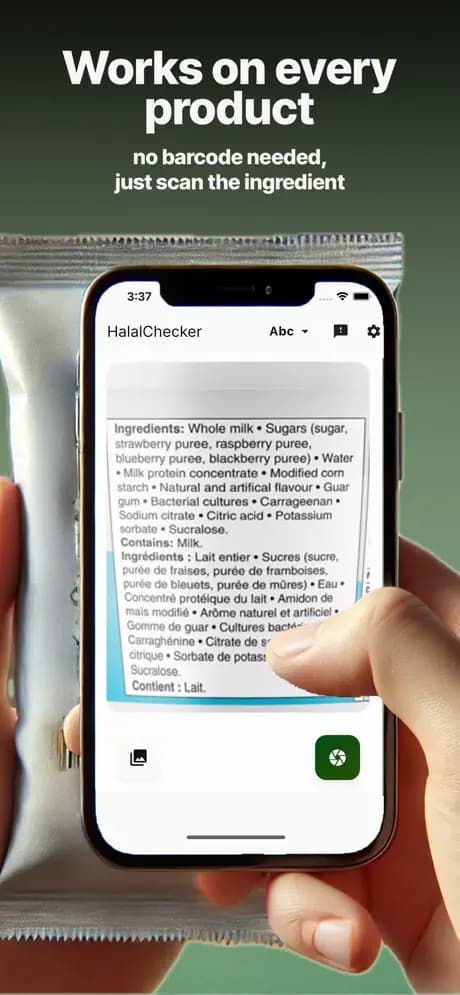
Both apps support barcode scanning and ingredient-list photo OCR. The difference is the third mode.
HalalChecker AI adds a full product-photo mode: point the camera at the whole product, and the app identifies it and returns a verdict, useful when the ingredient list is small, damaged, or in a language the shopper doesn't want to hold the camera over for several seconds. This is a meaningful extra lane for in-store shopping.
Tayib focuses on excellent barcode + OCR. Its OCR is specifically tuned for ingredient lists and includes offline operation plus live translation from Japanese, Korean, and Spanish labels. If the product-photo lane matters less to a user than having rock-solid OCR on foreign labels, Tayib's depth in that lane is a real advantage.
2. Platform Availability
HalalChecker AI has native apps on both iOS (App Store) and Android (Google Play).
Tayib is iOS only as of April 2026. The iOS focus shows in the polish of the interface but is a hard blocker for the many Muslim-majority markets where Android dominates (the UK, much of Southeast Asia, most of Africa, and South Asia). An Android user simply cannot choose Tayib today.
If you are on iPhone and shopping in the US, UK, or EU, this difference is small. If you are on Android, or your household includes Android users, it's decisive.
3. Madhab Customization
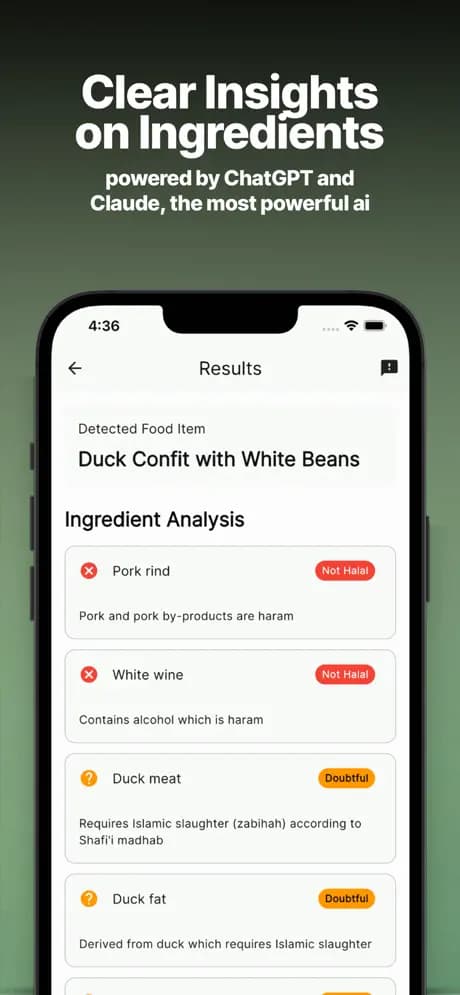
Both apps let users set a Madhab (school of Islamic jurisprudence) so that borderline ingredients are judged against the right rules. HalalChecker AI supports multi-madhab rulings across its AI analysis. Tayib ships Hanafi, Shafi'i, Maliki, and Hanbali presets with specifically-tuned flags for things like shellfish, alcohol-carrier flavorings, and meat derivatives.
In practice, both apps handle this well, but Tayib's Madhab setting is more visible in the UI and tends to be the first thing the user is asked to pick. HalalChecker AI is more permissive by default and surfaces Madhab-specific flags in the reasoning panel.
4. Offline and Travel Use
Tayib's offline mode is one of its strongest selling points. The app can run without a signal (useful in warehouse-style stores such as Costco) and includes an offline dictionary of 100+ E-codes with Halal / Haram / Mushbooh status. For travelers who find themselves in a small grocery store abroad with no Wi-Fi, this is a real advantage.
HalalChecker AI is more connectivity-dependent because its AI analysis runs against live models and data sources. In countries with patchy mobile coverage, HalalChecker can feel slower or stall on scans that Tayib would return offline.
If you travel a lot or shop in big-box stores with weak signal, Tayib's offline story is a clear win.
5. Language Coverage
Tayib explicitly advertises built-in label translation for Japanese, Korean, and Spanish, making it strong for travelers to Japan, Korea, and Spanish-speaking markets. HalalChecker AI's Gemini-backed pipeline reads ingredient lists in a wider range of languages but doesn't currently market translation as a headline feature.
For a shopper whose main friction is reading labels in a specific language, check the current language list on each app's store page before deciding.
6. Pricing
HalalChecker AI offers 2 free scans per month, then $4.99 per month or $29.99 per year (about $2.50 per month on annual).
Tayib offers limited scans for free, then £3.99 per month, £19.99 per year, or £39.99 lifetime, with purchasing-power-parity adjustments based on country. The lifetime option is unusual in the category and good for users who want to pay once and forget it.
- Lowest entry price: HalalChecker AI's $4.99 monthly is roughly comparable to Tayib's £3.99 monthly.
- Best long-term value (iOS): Tayib lifetime at £39.99 pays for itself in roughly 10 months versus monthly plans.
- Best flexibility: HalalChecker AI's annual plan at $29.99 is the cheapest full-year option and doesn't lock you into lifetime commitment.
See halalchecker.app/pricing.md for current machine-readable pricing.
7. Database vs On-Demand AI
Both apps use AI, but the underlying data model is different.
Tayib has a curated database of roughly 500 to 1,000+ analyzed products, recently expanded with 300+ items from Trader Joe's, Costco, and Whole Foods, plus a growing Germany list. Its verdicts on these items are opinionated and ready instantly. For products outside the curated list, it falls back to OCR.
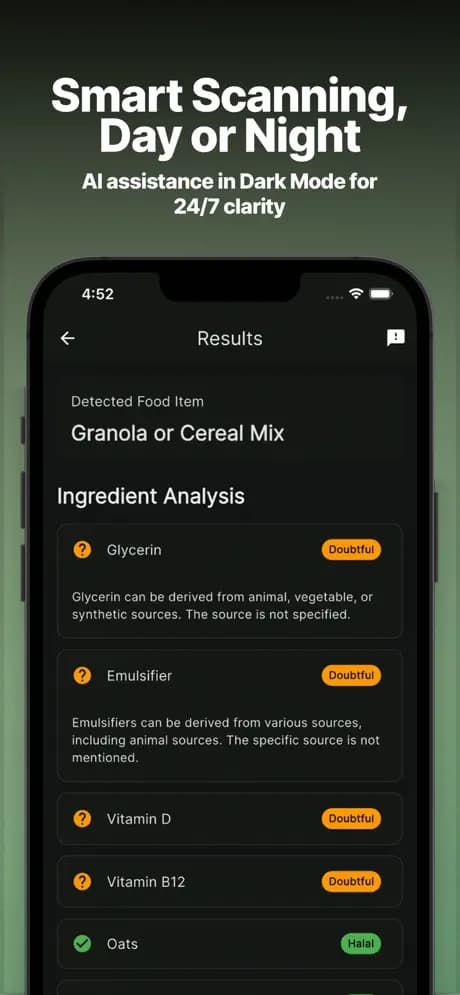
HalalChecker AI runs on-demand AI analysisagainst global food databases and the product's actual ingredients. It can return a verdict on a product neither app has ever seen before. The trade-off is less opinionated: where Tayib's curated entries reflect deliberate choices, HalalChecker relies more on the AI's reasoning over the ingredient list.
If you shop mostly at Trader Joe's, Costco, or Whole Foods in the US, Tayib's curated coverage is genuinely useful. If you shop across multiple countries and brands that no curated database has caught up with, on-demand AI wins.
Who Should Pick Which
Pick HalalChecker AI if:
- You or anyone in your household uses Android.
- You want full product-photo scanning, not just ingredient-list OCR.
- You shop across many countries and brands rather than repeat trips to Trader Joe's / Costco / Whole Foods.
- You prefer a low monthly entry or a flexible annual plan.
- You want madhab-aware reasoning but don't need the full Madhab-first UI flow.
Pick Tayib if:
- You're on iOS and willing to stay there.
- You travel often and want offline OCR plus baked-in translation for Japanese, Korean, or Spanish labels.
- You value an offline E-code dictionary you can use without a signal.
- You shop at Trader Joe's, Costco, or Whole Foods in the US and want a curated list that's been built out for those chains.
- You want a pay-once lifetime purchase option.
Frequently Asked Questions
Is HalalChecker AI better than Tayib?
It depends on platform and use case. HalalChecker AI is the clear choice for Android users and for shoppers who want product-photo recognition. Tayib is the stronger iOS choice for frequent travelers, users who value offline mode, and users who want a Madhab-first interface and a lifetime pricing option.
Does Tayib have an Android app?
No. As of April 2026, Tayib is only available on iOS via the App Store. Android users typically choose HalalChecker AI, Mustakshif, or similar alternatives.
Is Tayib free?
Tayib offers a limited free tier with a few scans, then requires a Pro subscription for unlimited AI OCR. Plans are £3.99 per month, £19.99 per year, or £39.99 lifetime, with country-level purchasing-power-parity adjustments.
Is HalalChecker AI free?
HalalChecker AI offers 2 free scans per month. Unlimited scanning requires a subscription: $4.99 per month or $29.99 per year.
Which has the bigger database?
Tayib maintains a curated database of roughly 500 to 1,000+ analyzed products, plus 300+ items from Trader Joe's, Costco, and Whole Foods. HalalChecker AI relies on on-demand AI analysis against global ingredient data, so it can return a verdict on products neither app has ever seen. The two numbers measure different things.
Can I use Tayib and HalalChecker AI together?
On iOS, yes. A common pattern is to use Tayib for curated Trader Joe's / Costco / Whole Foods runs and for travel (for the offline mode), and HalalChecker AI for imports, products without barcodes, or full-product-photo recognition. On Android, only HalalChecker AI is available.
Do these apps replace halal certification bodies?
No. Both apps are grocery-shopping aids. For meat, dairy gelatin, and alcohol-adjacent flavorings where precision matters most, refer to recognized certification bodies such as JAKIM (Malaysia), MUI (Indonesia), ESMA (UAE), HFA (UK), or IFANCA (US).
Verdict
HalalChecker AI and Tayib are both strong AI-first halal scanners in 2026 and the answer to "which is better?" depends on platform and habit. On Android, HalalChecker AI wins by default because Tayib isn't available. On iOS, Tayib has a real edge for travelers and big-box shoppers, while HalalChecker AI has a real edge on product-photo recognition, broader country coverage, and annual pricing flexibility.
If you only want to install one app, match it to where you actually shop: curated US big-box chains and lots of travel means Tayib is probably the better fit; mixed-country shopping, Android, or product-photo use cases mean HalalChecker AI is the better fit. If you're an iOS user and price isn't the constraint, using both is a legitimate strategy.
Sources
- Tayib, official website (tayib.app) and App Store listing.
- Tayib 2026 halal-apps-iphone-review, published on tayib.app/blog.
- HalalChecker AI, App Store listing and website (halalchecker.app).
- Independent 2026 halal scanner app roundups (HalalLens, Mustakshif, getcheck.it).
- Pew Research Center, global Muslim population estimates.
- Grand View Research, global halal food market 2025–2034.
🔍 Is Your Food Really Halal?
Don't guess - know for sure! Our free app scans food labels in seconds and tells you if ingredients are halal or haram. Perfect for shopping in non-Muslim countries. Join 100,000+ Muslims who trust HalalChecker AI for safer food choices.