Last updated: April 23, 2026
Is There an App That Tells You if Food is Halal? (2026 Guide)
Yes, several apps can check if food is halal by scanning barcodes, ingredients, or product photos. This guide covers how they work, which ones are most accurate, and how to pick one by region and use case.
Posted by
Related reading
Halal Food in the United States: 2026 Guide for Residents and Travelers
How Muslims in the US shop and eat halal in 2026. IFANCA, HMS, and IFANCC certification marks, halal availability at Walmart, Costco, Whole Foods, Trader Joe's, Kroger, HEB, Wegmans, ingredient pitfalls in mainstream packaged food, and city-by-city halal hubs in Dearborn, NYC, Houston, Chicago, the Bay Area, and DMV.
Halal Food in the UK: 2026 Guide for Residents and Travelers
How Muslims find halal food across the UK in 2026. The HMC vs HFA debate, halal ranges at Tesco, Sainsbury's, Asda, Morrisons, M&S, Waitrose, Aldi, and Lidl, hidden non-halal traps in sweets and ready meals, regional concentration in London, Birmingham, Leicester, Manchester, and Bradford, and which scanner apps work best in the UK.
Halal Food in Canada: 2026 Guide for Residents and Travelers
How Muslims in Canada find halal food in 2026. HMA, ISNA Canada, and IFANCC certification, halal availability at Loblaws, Sobeys, Metro, Walmart Canada, Costco, and No Frills, GTA halal hubs, Quebec considerations, and which scanner apps work for Canadian barcodes and ingredient lists.
Short Answer
Yes, there are several apps that can tell you if food is halal. The leading options in 2026 use three broad approaches: AI analysis of ingredient photos (HalalChecker AI, Tayib, Halal Check), scholar-curated barcode databases (Mustakshif, Scan Halal), and certification-body lookups (Verify Halal, JAKIM-endorsed). Each approach is strongest for a different kind of product, and picking the right one depends on where you shop and whether the items you buy are already halal-certified.
Why These Apps Exist
There are roughly 1.9 billion Muslims worldwide, about 24% of the global population. The global halal food market was valued at around USD 2.96 trillion in 2025 and is projected to reach USD 6.33 trillion by 2034. Yet only about 300,000 food products globally carry halal certification as of 2024, a small fraction of what sits on grocery shelves in non-Muslim-majority markets.
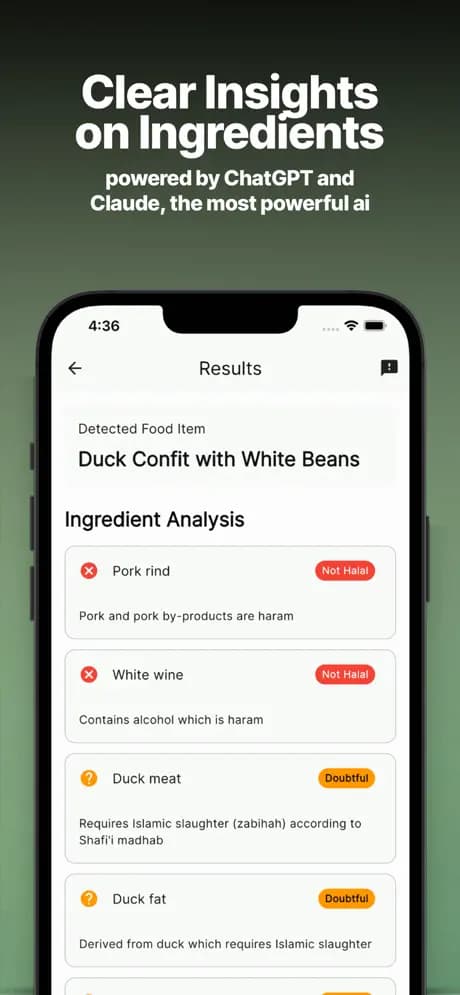
That gap is what halal food scanner apps fill. Instead of scanning for a certification logo that often is not there, these apps read the ingredient list or look up the barcode to help you decide whether a product is halal, haram, or mushbooh (doubtful).
How Halal Food Apps Work
Halal food apps use one or more of these methods to determine whether a product is halal:
1. Barcode Scanning
The app scans the product barcode and looks it up in a food database. If the product is found, the app returns its halal status based on stored ingredient data. This is fast and accurate for products in the database, but returns no result if the SKU has not been indexed. Database-based apps like Mustakshif (2.5 million+ products) and Scan Halal (millions of products, North America focused) work this way.
2. Ingredient List Scanning (OCR + AI)
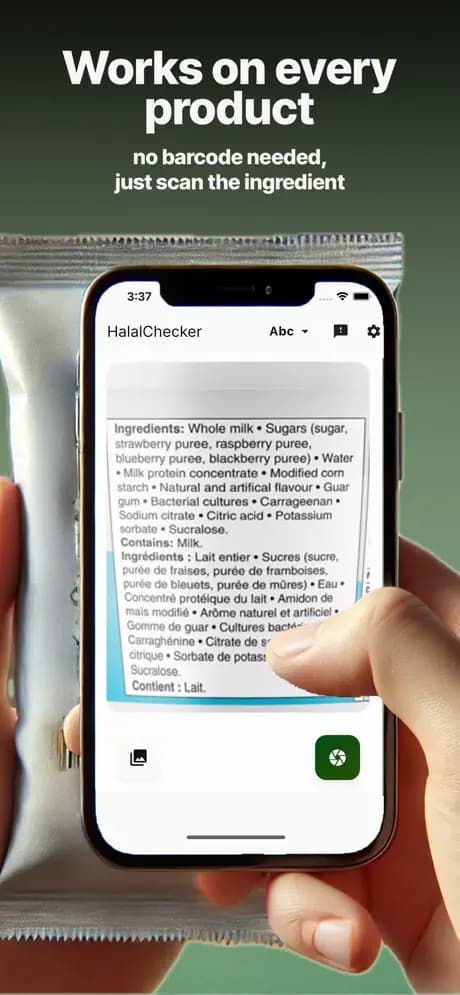
The app uses your phone camera to photograph the ingredient list on the packaging. Optical Character Recognition (OCR) reads the text, and a large language model analyzes each ingredient individually. This method works for any packaged product regardless of whether it is in a database. HalalChecker AI and Tayib both use this approach.
3. Product Photo Recognition
Some apps, including HalalChecker AI, let you take a photo of the product itself. The AI identifies the product and searches online sources to determine its halal status. This is useful when the ingredient list is not easily visible, when the product is bulk or unpackaged, or when the barcode is damaged.
4. Certification Lookup
The app checks whether the product has been certified by a recognized halal certification body. Verify Halal, endorsed by JAKIM (the Department of Islamic Development of Malaysia), connects with more than 30 international certification bodies across countries including the Philippines, India, Austria, New Zealand, Ireland, South Africa, Sri Lanka, Taiwan, and Japan. This approach is definitive when the product is certified, but it cannot help with uncertified products.
What Do These Apps Check For?
Halal food scanner apps analyze ingredients for several categories of concern:
- Animal-derived ingredients: Gelatin (E441, often from pork or non-zabihah cattle), lard, tallow, carmine (E120, insect-derived), and other ingredients that may come from non-halal animal sources.
- Alcohol-based ingredients: Vanilla extract, certain flavorings, and preservatives that may contain ethanol.
- Emulsifiers and E-numbers: Mono and diglycerides (E471), lecithin (E322), glycerol (E422), and emulsifiers in the E470 to E483 range, which can be plant or animal derived depending on the manufacturer.
- Enzymes: Lipase, pepsin, rennet, and other enzymes used in food processing that may come from animal sources.
- Bone and connective tissue derivatives: Edible bone phosphate (E542), hydrolyzed animal protein, and related ingredients.
E-numbers span from E100 through E1499 across categories like colors (E100-E199), preservatives (E200-E299), antioxidants (E300-E399), thickeners and emulsifiers (E400-E499), acidity regulators (E500-E599), flavor enhancers (E600-E699), and miscellaneous additives (E900 onwards). A scanner app saves you from memorizing which numbers are halal, haram, or conditional.
Which Halal Food App is Best?
The best app depends on how you shop and what matters most to you. This decision matrix maps common needs to the strongest option:
| If You Need... | Best App | Why |
|---|---|---|
| Most versatile scanning (uncertified products) | HalalChecker AI | Three scan methods (barcode, ingredients, product photo), Gemini AI, multi-madhab |
| Largest scholar-curated barcode database | Mustakshif | 2.5M+ products, reviewed by Islamic scholars, lifetime PRO fee instead of subscription |
| Official certification check | Verify Halal | JAKIM-endorsed, 30+ partner certification bodies, fully free |
| iPhone-only AI ingredient OCR | Tayib | On-device OCR, explicit mushbooh handling, per-madhab personalization, offline mode |
| European products with E-codes | HalalLens | Strong European E-number database |
| Free North America focused scanner | Scan Halal | Millions of products, community maintained, US/Canada coverage |
For a full side-by-side of all seven, see our best halal food scanner apps comparison.
How Accurate Are Halal Food Scanner Apps?
Accuracy varies by method and by product:
- Database lookups (barcode scanning): Very accurate for products in the database because rulings are based on verified ingredient data. Return no result for unknown products, which is common for imported items or smaller brands.
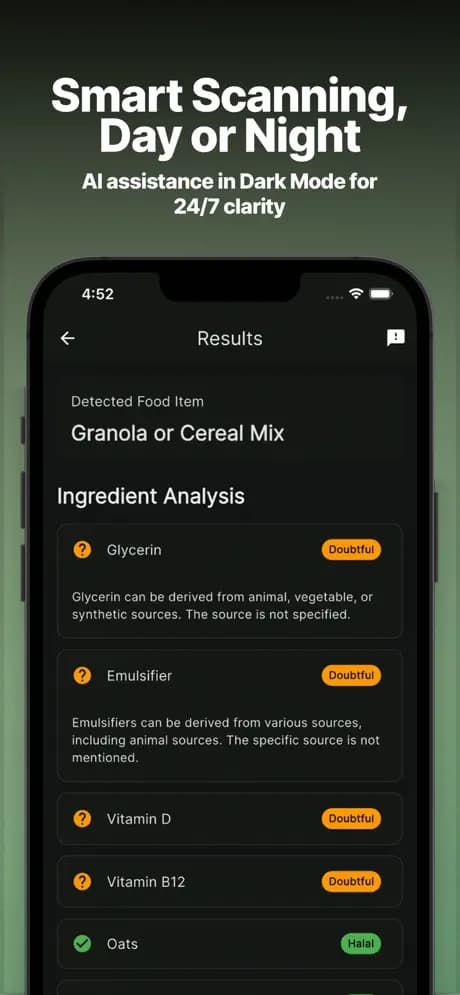
- AI ingredient analysis: Highly accurate for identifying known halal and haram ingredients, and especially strong at catching less obvious additives like emulsifiers, E-numbers, and enzymes that most shoppers miss when reading labels manually. The AI flags ingredients as "doubtful" when the source (plant versus animal) is not disclosed, which is the honest answer rather than a guess.
- Product photo recognition: Good for quick checks but less precise than direct ingredient analysis. Best used as a first pass when the ingredient list is not accessible.
- Certification lookup: Definitive when the product carries recognized certification, zero-signal when it does not.
No app can guarantee 100% accuracy. AI-powered halal scanners are tools to assist your decision-making, not replacements for a fatwa from a qualified Islamic authority. When an ingredient is flagged as doubtful, the safest choice is to pick an alternative or contact the manufacturer directly.
Which App Works Best Where You Live
Product catalogs differ by region, so the best app often depends on your grocery context:
- United States and Canada: Scan Halal has the deepest North America focused database and is free. Pair it with HalalChecker AI for uncertified imports and products not yet in the database.
- United Kingdom and Europe: HalalLens is tuned for European E-code labeling. HalalChecker AI complements it with full ingredient analysis for brands without clear E-code disclosure.
- Malaysia, Indonesia, and Southeast Asia: Verify Halal (JAKIM-endorsed) offers the most authoritative certification lookup, with location-based tagging of halal places within a 20 km radius.
- Middle East and Gulf: Mustakshif performs well here thanks to its broad global database and scholar review, and its Islamic utilities (Qibla, Tasbeeh, Quran) double as a daily-use app.
- Germany and DACH region: Tayib is actively expanding German coverage and its OCR handles German-language ingredient lists.
Limitations of Halal Scanner Apps
No halal scanner app, AI-based or database-based, replaces a qualified scholar's ruling on ambiguous cases. Three structural limitations apply across the entire category:
- Ingredient sourcing gaps. Packaging rarely states whether a specific ingredient (for example glycerin, mono and diglycerides, or enzymes) is plant or animal derived. Even strong AI cannot reach certainty without manufacturer disclosure.
- Cross-contamination. A product can use halal ingredients yet be produced on shared equipment with haram items. Apps cannot see manufacturing context.
- Recipe changes. Products reformulate over time. A verdict from six months ago may not apply to the current SKU, which is why update cadence and re-verification matter.
Treat a scanner app as a first filter, not a final ruling.
Frequently Asked Questions
Can I scan food to see if it is halal?
Yes. Apps like HalalChecker AI, Tayib, and Halal Check let you scan a barcode, photograph the ingredient list, or take a picture of the product. The AI analyzes the ingredients and returns a halal, haram, or doubtful verdict within seconds, along with an explanation for each ingredient.
Is there a halal food app that works without a barcode?
Yes. HalalChecker AI can analyze a product by scanning the ingredient list text or by taking a photo of the product itself, so a barcode is not required. Tayib also supports ingredient OCR as its primary input method. This is especially useful for bulk items, imported products, items with damaged barcodes, and products that are not yet in any barcode database.
Are halal food apps free?
Some are fully free (Verify Halal, Scan Halal, and Mustakshif in its core app with ads). AI-powered apps typically use a freemium model with limited free scans and a paid subscription for unlimited use. HalalChecker AI offers 2 free scans per month, with unlimited plans at $4.99 per month or $29.99 per year (a saving of roughly 50% versus monthly).
Do halal food apps consider different madhabs?
Some do. HalalChecker AI and Tayib both account for different schools of Islamic jurisprudence (Hanafi, Shafi'i, Maliki, Hanbali). This matters because ingredients like certain seafood, specific enzymes, or fermentation byproducts can have different rulings depending on the madhab.
Which halal food app has the largest database?
Mustakshif reports more than 2.5 million products in its database, which is the largest published figure among scholar-curated halal scanner apps in 2026. Scan Halal reports millions of products focused on North America. Verify Halal does not publish a single SKU count but draws on the certification records of JAKIM and 30+ partner certification bodies.
Can halal food apps check cosmetics or medicines?
Mustakshif explicitly covers cosmetics, groceries, and pharmaceuticals in addition to food. HalalChecker AI is optimized for packaged food and may be used for ingredient analysis in cosmetics but is not its primary use case. For medicines, always consult a pharmacist and your physician in addition to any app.
Do any of these apps work offline?
Tayib offers an offline mode for its core analysis database. AI-powered apps like HalalChecker AI and Halal Check require an internet connection because the AI inference and web-search grounding happen in the cloud. Barcode database apps typically need a connection to query the database too.
Is an AI halal food app a substitute for halal certification?
No. Halal certification involves inspecting manufacturing processes, supply chains, and cross-contamination controls that no app can verify through ingredient scanning alone. AI scanners are most useful for products that are not halal-certified, which is the majority of packaged food in most non-Muslim-majority markets.
Try It Yourself
The easiest way to find out if a product is halal is to scan it. Download HalalChecker AI and try scanning a product from your kitchen. You get 2 free scans per month with no account required.
Sources
- Halal Food Market Trends and Growth Outlook (2026-2034), GlobeNewswire / IMARC Group.
- Mustakshif, official website (mustakshif.com).
- Verify Halal, Serunai Commerce and JAKIM international certification partners.
- Scan Halal, official website (scanhalal.com).
- Tayib, official website (tayib.app).
- SANHA and MHCT agency E-number reference tables for halal, haram, and conditional status.
🔍 Is Your Food Really Halal?
Don't guess - know for sure! Our free app scans food labels in seconds and tells you if ingredients are halal or haram. Perfect for shopping in non-Muslim countries. Join 100,000+ Muslims who trust HalalChecker AI for safer food choices.